

From the silent walls of ancient Roman villas to the immersive digital and physical installations of the 21st century, flowers have held a permanent residency in the world of art.Far more than mere ornaments, they serve as a sophisticated visual language. Throughout history, artists have utilized the shape, color, fragrance, and even the religious associations of blooms to convey complex human emotions and societal beliefs.
While cultural interpretations fluctuate, the allure of the floral motif remains a universal constant, continually reinvented across styles and eras.
👉 Watch the complete video on YouTube.
Antiquity and the Roots of Symbolism
In the ancient world, floral motifs were ubiquitous, decorating the very floors and walls of living spaces. For the ancients, flowers were dualistic: they celebrated the abundance of nature while simultaneously serving as a sobering reminder of life’s transience.
The rose, in particular, carried a heavy weight of significance. In ancient Rome, it was deeply tied to funerary rites. The “Rosalia,” or Feast of Roses, was a ceremony dedicated to honoring the dead. A stunning 3rd-century Roman mosaic currently housed in the Vatican Museums (specifically the Hall of the Greek Cross) perfectly captures this early fascination. Featuring a detailed bouquet against a dark background, it highlights an appreciation for botanical precision that would only grow in the centuries to follow.
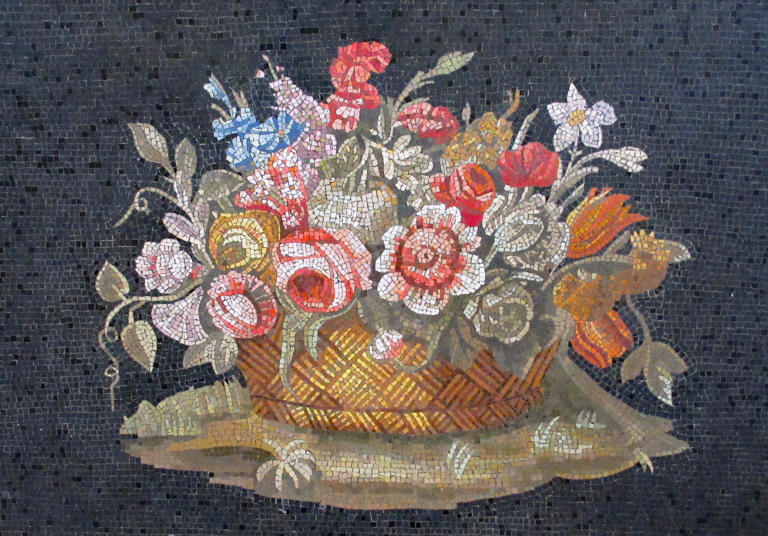
Roman mosaic with basket of flowers,
c. 3rd Century
The Meticulous Traditions of the East
In Chinese art, the portrayal of flora—often categorized as huaniaohua (bird-and-flower painting)—is rarely just about aesthetics. Every plant and animal serves as a “rebus” or a carrier of beneficial meaning. Two distinct styles define this tradition: Gongbi, which is meticulous and realistic, and Xieyi, which is more free-form and interpretive.
A landmark of this tradition is Li Di’s “Red and White Cotton Roses” (1197). Executed in the Gongbi style, this masterpiece is celebrated for its luminous colors and clinical precision, capturing the delicate nature of the cotton rose with a level of detail that feels almost living.
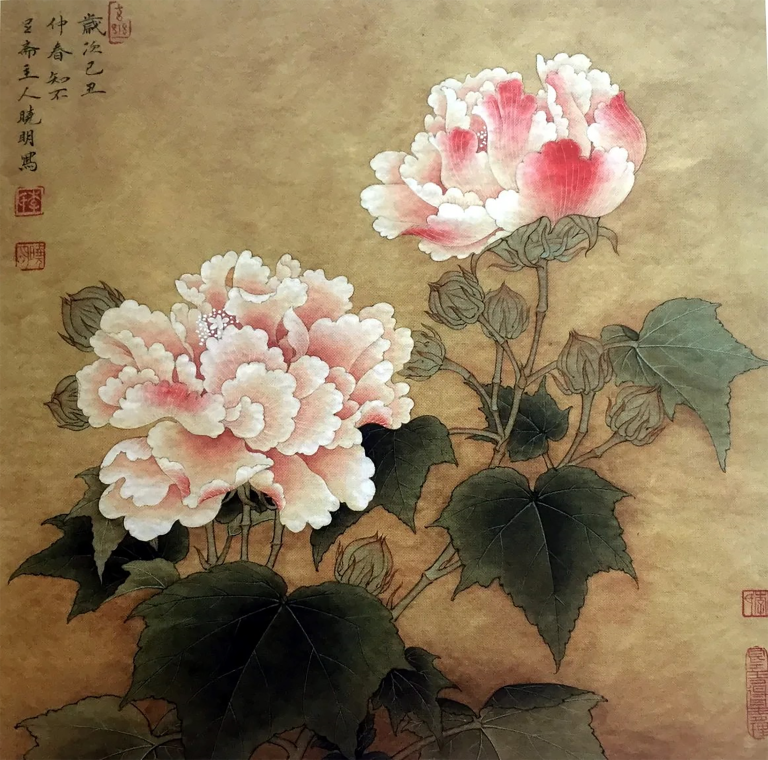
Li Di,
Red and White Cotton Roses,
1197
Faith and Purity: The Christian Rose and Lily
As art moved into the Middle Ages and the Renaissance, flowers became inseparable from Christian iconography. The rose, once a funerary symbol in Rome, was reinterpreted through the lens of martyrdom and the Virgin Mary.
In Stefan Lochner’s “Madonna of the Rose Bower,” the Virgin is depicted as the “Queen of Heaven” beneath a rose trellis. Legend suggested that roses were thornless before the Fall of Man; thus, Mary became known as the “rose without thorns,” signifying her freedom from original sin.
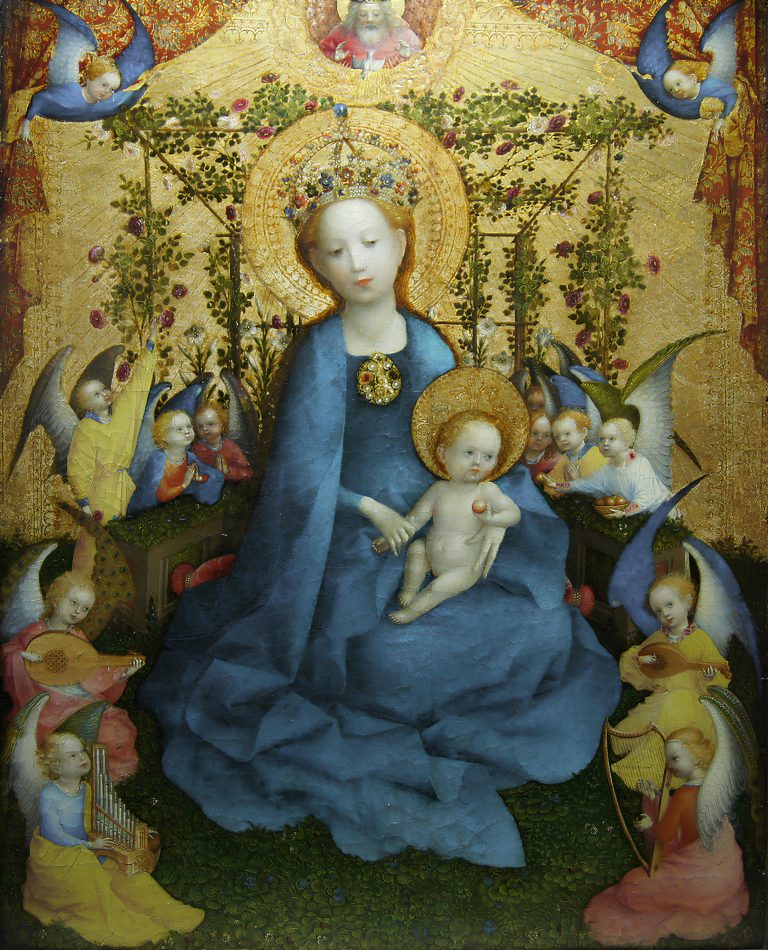
Stefan Lochner,
Madonna of the Rose Bower,
1440
Similarly, the lily emerged as the quintessential symbol of purity. Pliny the Elder had previously noted its “immaculate whiteness,” but in Leonardo da Vinci’s “Annunciation” (c. 1472–75), the white lily held by the archangel Gabriel explicitly confirms Mary’s virginity. Beyond its religious weight, the lily also transitioned into the political sphere, appearing on the coats of arms of the French monarchy and the city of Florence.
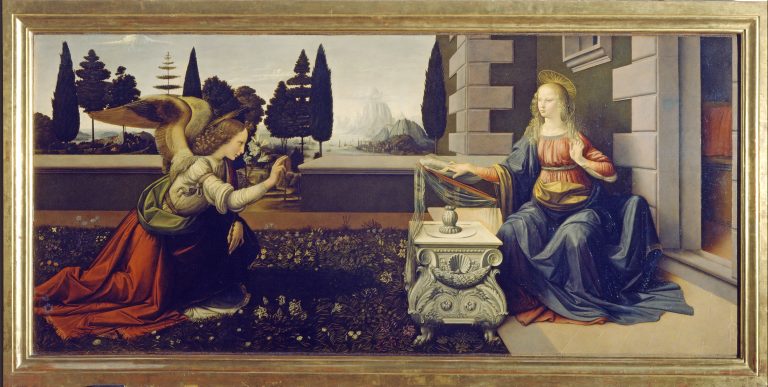
Leonardo da Vinci,
The Annunciation,
c. 1475
The Renaissance Bloom: Botticelli and Arcimboldo
The Renaissance also looked back to classical mythology, where the rose was the sacred flower of Venus. Sandro Botticelli’s “The Birth of Venus” shows the goddess arriving on shore as Zephyrus blows flowers through the air. This work is frequently paired with his “Primavera,” an astonishing botanical record containing over 500 plant species and 190 accurately depicted flowers.
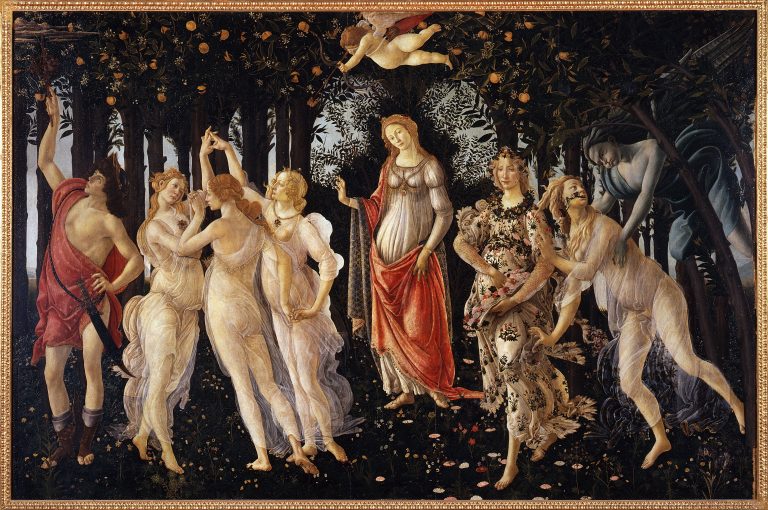
Sandro Botticelli,
La Primavera,
c. 1480
While Botticelli used flowers to create a setting, Giuseppe Arcimboldo used them to create the subject itself. In his “La Primavera”, he composed a human portrait entirely out of floral elements, symbolizing the renewal of life through a composite of nature’s bounty.
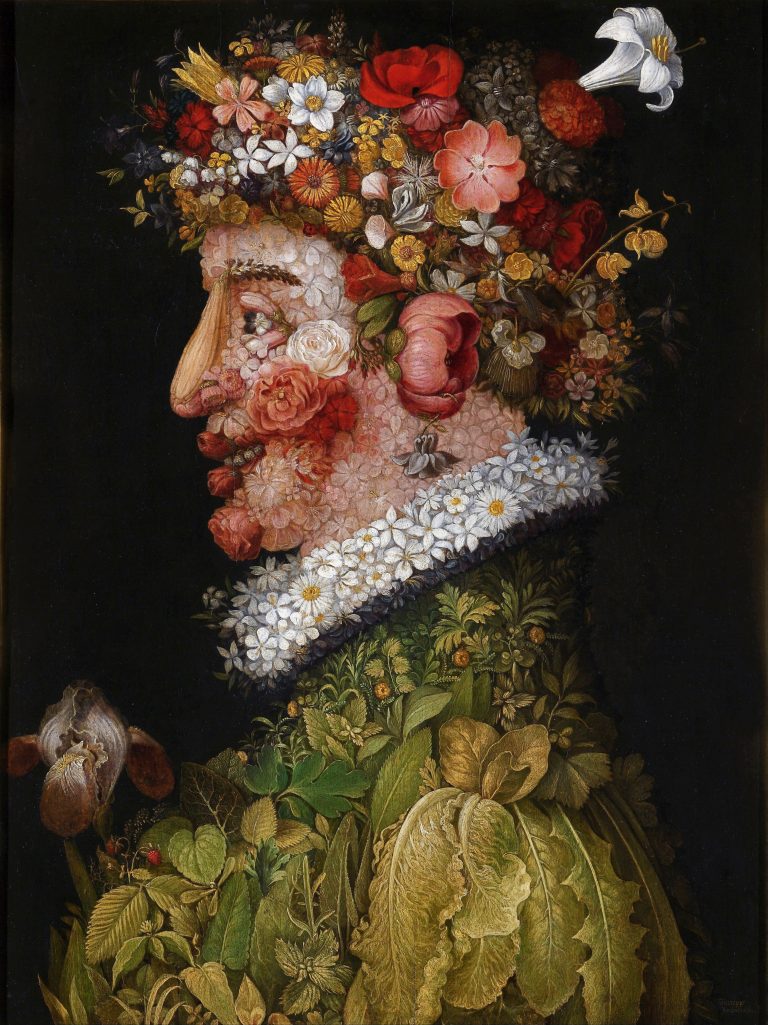
Giuseppe Arcimboldo,
La Primavera,
1573
The Dutch Golden Age and the Tulip Mania
The 17th century saw the rise of the specialized floral still life in the Netherlands. Artists like Ambrosius Bosschaert set the standard with symmetrical, vibrant bouquets. To achieve maximum brilliance, Bosschaert often painted on copper rather than canvas, using monochromatic backgrounds to make the expensive tulips and seasonal blooms “pop.”
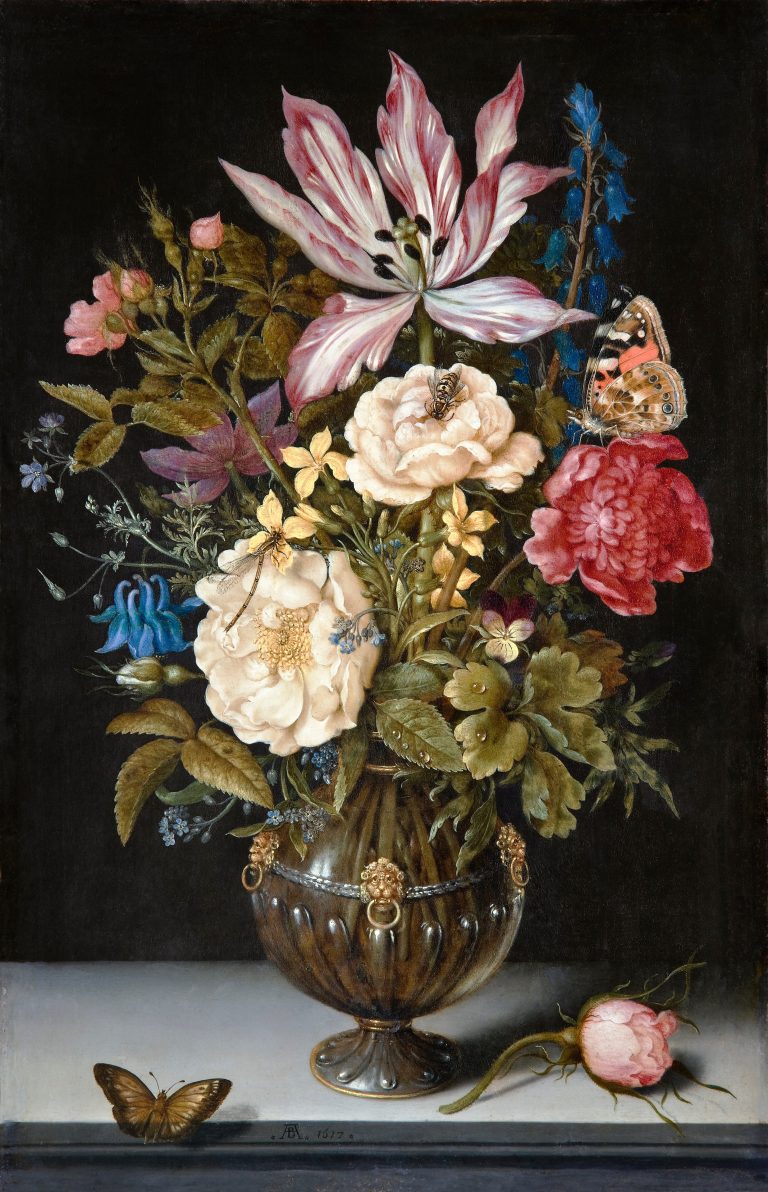
Ambrosius Bosschaert the Elder,
Flower Still Life,
1609
The tulip itself has a fascinating history. Imported from Persia in the 16th century, it triggered a speculative “stock exchange” in Amsterdam. Beyond its status as a luxury commodity, some viewed the tulip as an emblem of divine love, noting how it withers when separated from the sun.
Devotion and “Memento Mori”
The sunflower also took on deep meaning during this era. Rooted in Ovid’s Metamorphoses—the story of Clytie turning toward the sun in despair—the flower became a symbol of unconditional devotion. Anthony van Dyck’s “Self-Portrait with a Sunflower” utilizes this, showing the artist with a sunflower as a gesture of loyalty to his patron, King Charles I.
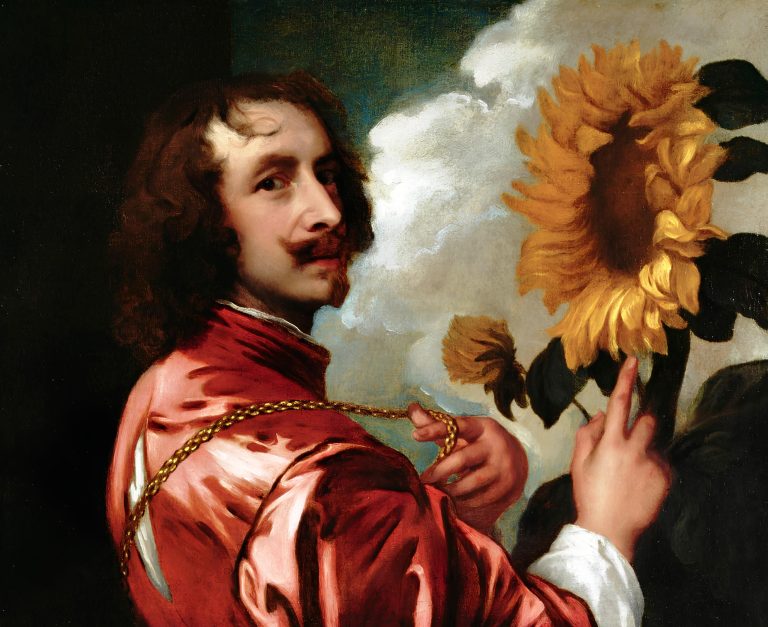
Anthony van Dyck,
Self-portrait with a Sunflower,
c. 1633
As the style evolved into the 18th century, artists like Jan van Huysum moved away from the rigid order of early Dutch works toward more dynamic, cascading arrangements. However, they kept the “memento mori” details—tiny insects and butterflies hidden among the petals to remind the viewer that beauty is fleeting.
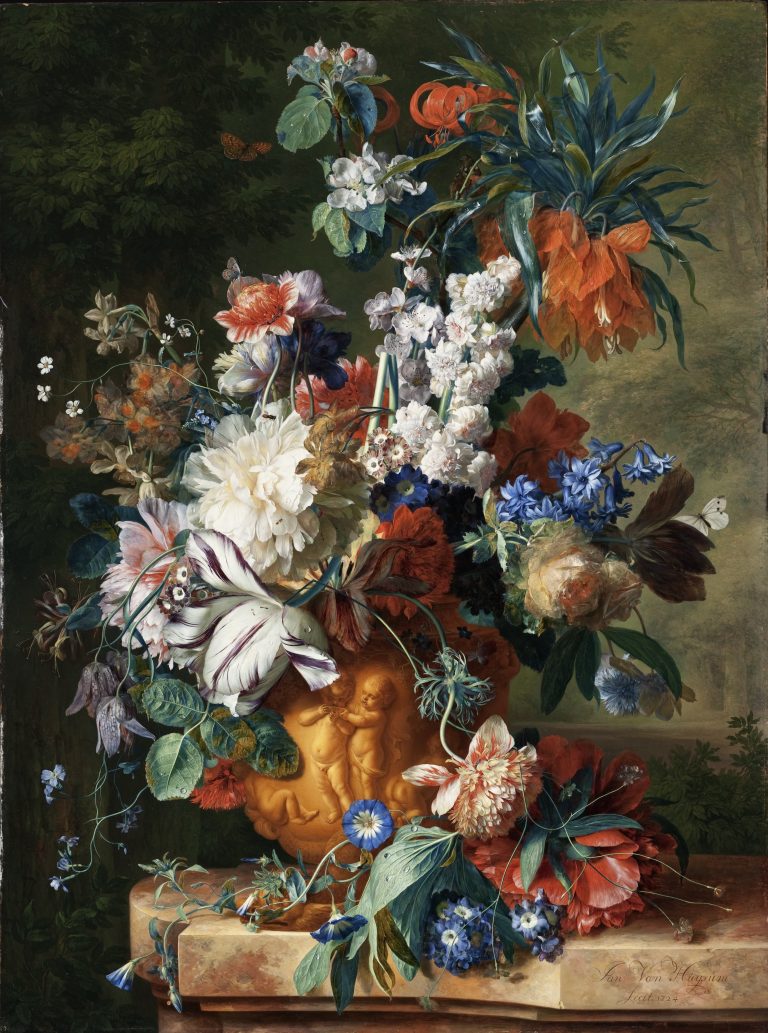
Jan van Huysum,
Bouquet of Flowers in an Urn,
c. 1725
Royalty and Botany
Flowers also played a role in shaping the public image of the monarchy. Élisabeth Louise Vigée Le Brun’s famous portrait of Marie-Antoinette features the Queen holding a rose, a gesture designed to humanize her and signal her patronage of the arts and sciences. This era also saw the rise of Pierre-Joseph Redouté, the “official painter” to both Marie-Antoinette and later Josephine de Beauharnais, whose watercolor botanical illustrations of lilies and roses remain the gold standard for scientific art.
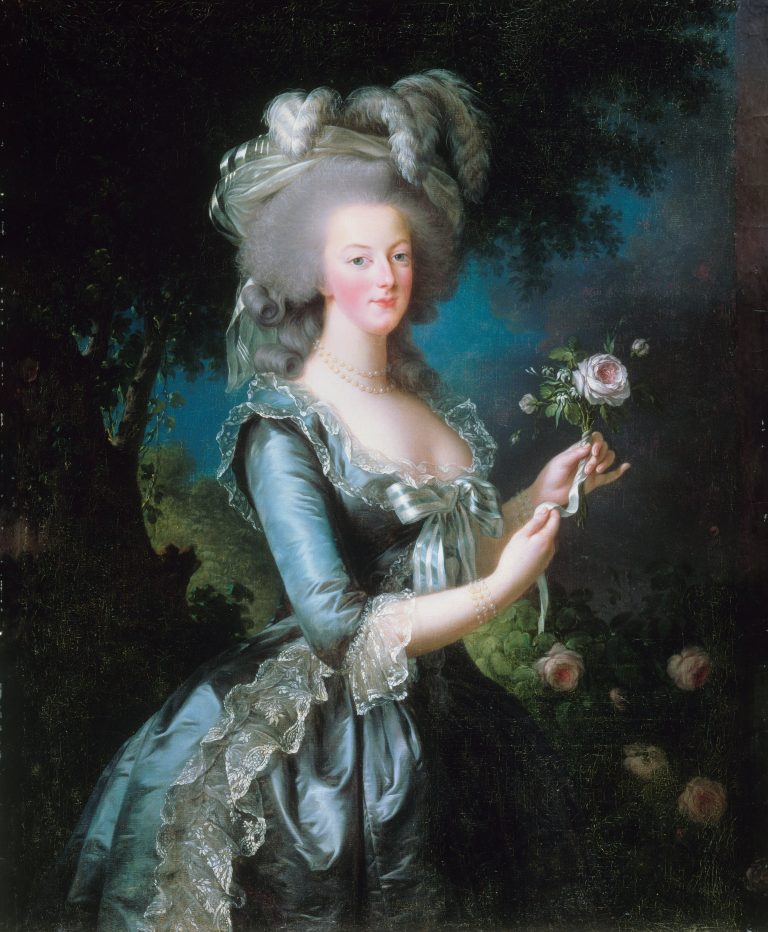
Louise Elizabeth Vigée Le Brun,
Marie-Antoinette with the Rose,
1783
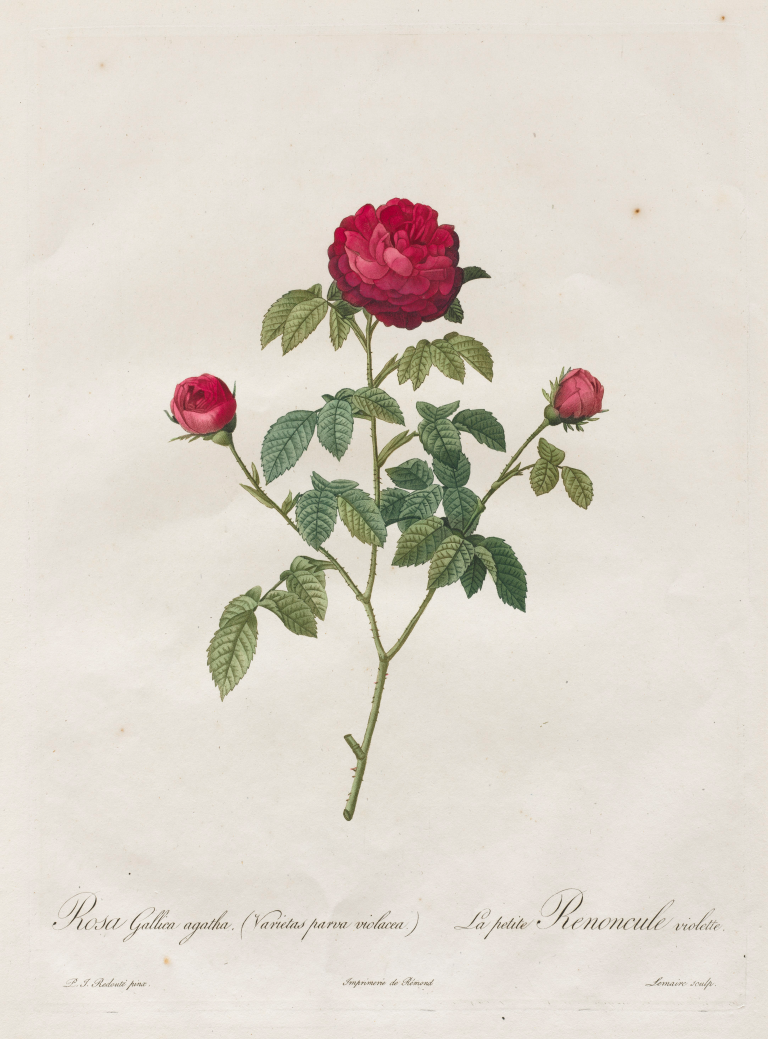
Pierre-Joseph Redouté,
Roses,
c. 1820
The Impressionist Revolution
By the late 19th century, the focus shifted from symbolic meaning to the study of light and fleeting moments. Claude Monet used peonies, hydrangeas, and lilacs to experiment with dynamic brushstrokes. In his later years at Giverny, he famously focused on his “Water Lilies” series, eventually removing all landmarks like bridges or horizons to immerse the viewer entirely in the reflections of his pond.
Other Impressionists used flowers to define atmosphere:
- Pierre-Auguste Renoir: In “Woman with Parasol in a Garden,” he used tiny dabs of color to interweave the textures of shrubs and flowers.
- Mary Cassatt: Her “Lilacs in a Window” (1879) stands as a rare still life in her oeuvre, capturing the quietude of domestic life.
- Édouard Manet: In the final year of his life, Manet painted at least 20 floral still lifes, such as “White Lilacs in a Glass Vase,” finding beauty in the gifts brought by friends to his bedside.
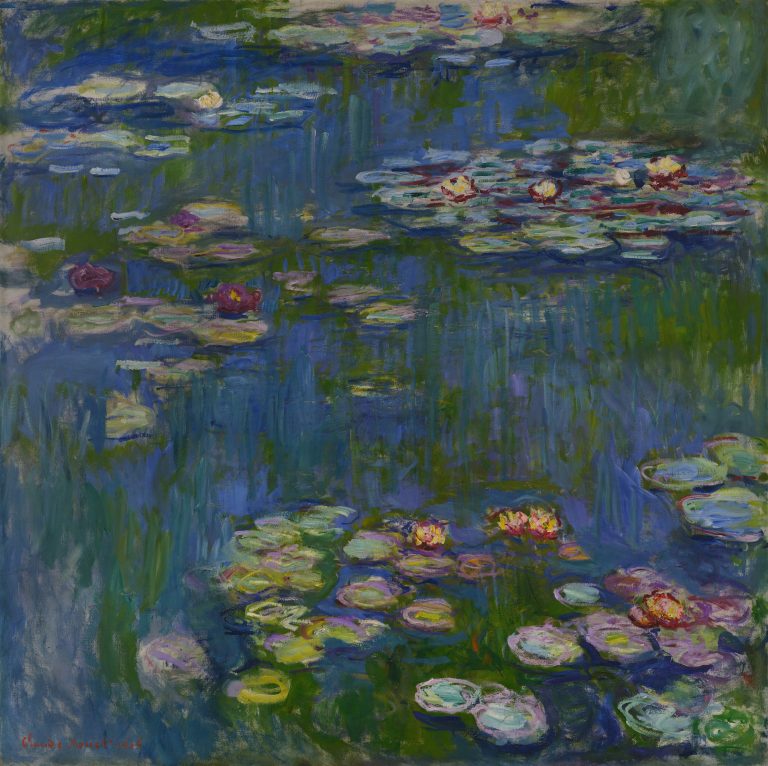
Claude Monet,
Water Lilies,
c.1916
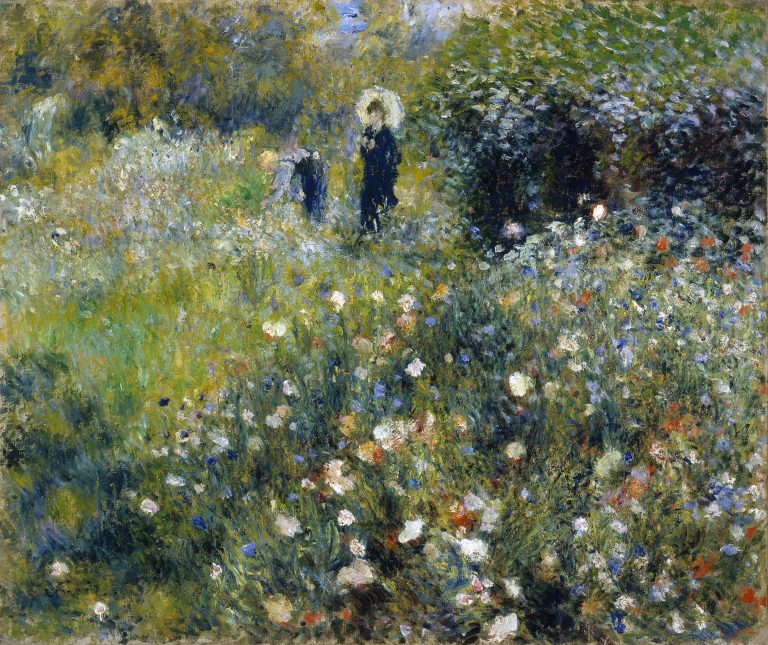
Pierre-Auguste Renoir,
Woman with a Parasol in a Garden,
1875
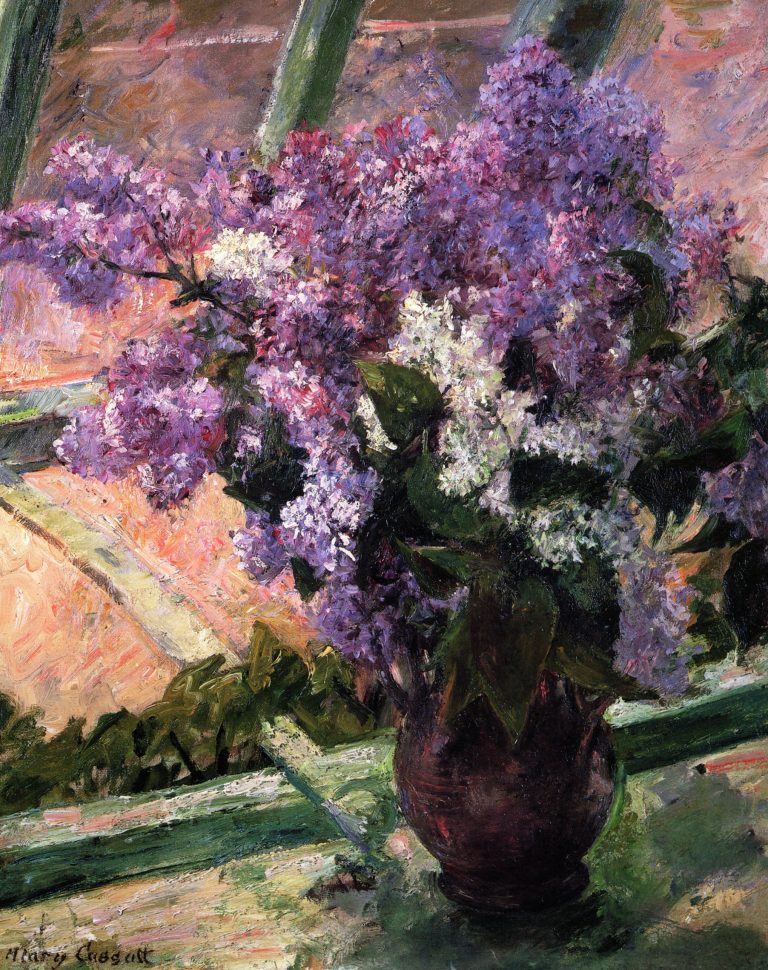
Mary Cassatt,
Lilacs in a Window,
1879
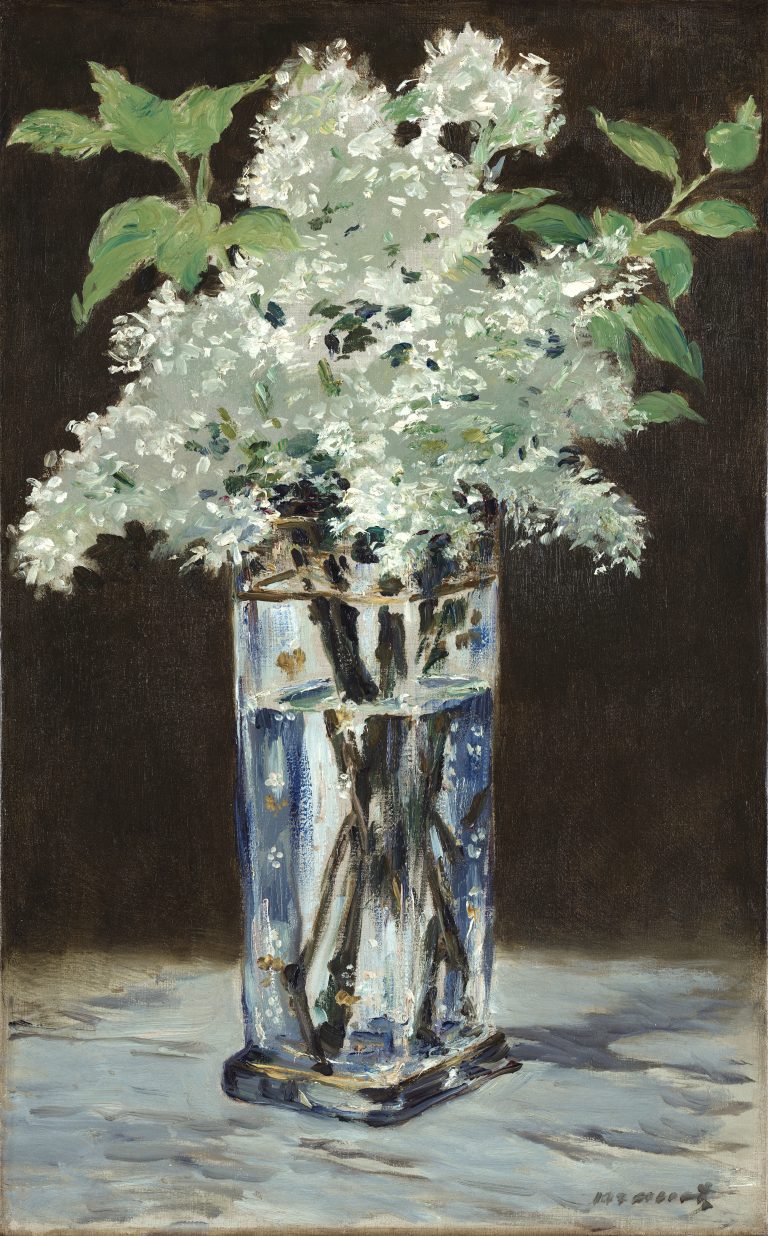
Edouard Manet,
White Lilacs in a Glass Vase,
1882
Post-Impressionism and Emotional Expression
For Vincent van Gogh, flowers were more than subjects; they were emotional vessels. His “Sunflowers” symbolized gratitude, while the “Irises” he painted at the asylum in Saint-Rémy were studies in color contrast—placing blue-violet petals against yellow backgrounds to make them “strengthen each other.”
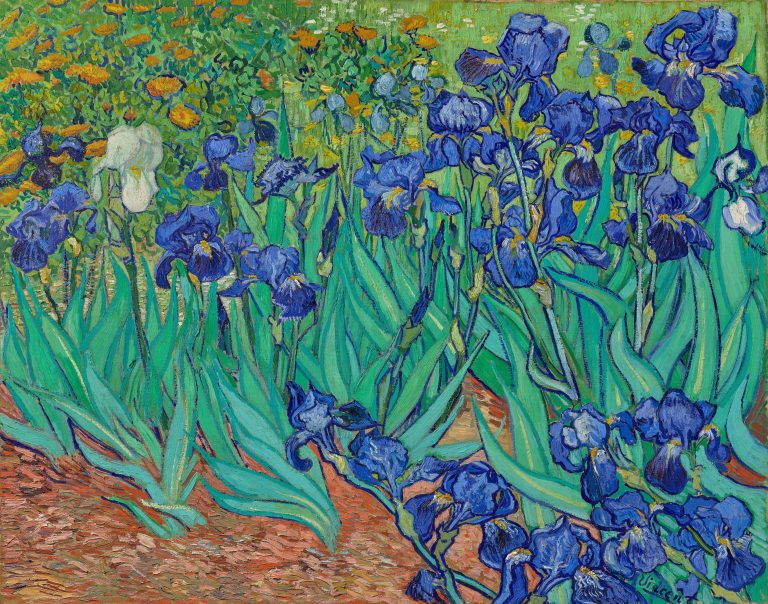
Vincent van Gogh,
Irises (Front),
1889
Similarly, Paul Gauguin used peonies to mark his transition from stockbroker to artist, while his later Tahitian works, such as “Still Life with Flowers and Idol,” fused Western traditions with Polynesian spirituality.
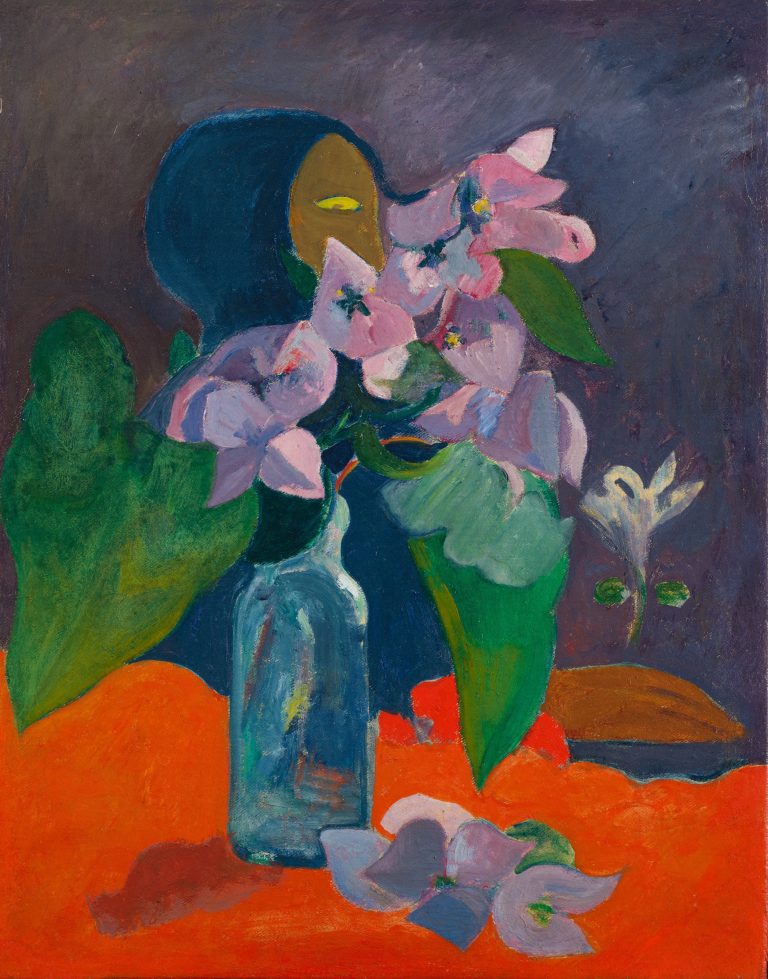
Paul Gauguin,
Still Life with Flowers and Idol,
1892
In his Fauvist still lifes, Henri Matisse‘s flowers were reduced to pure, rhythmic silhouettes—vessels for “expression” and the “joy of life” rather than mere botanical imitation.
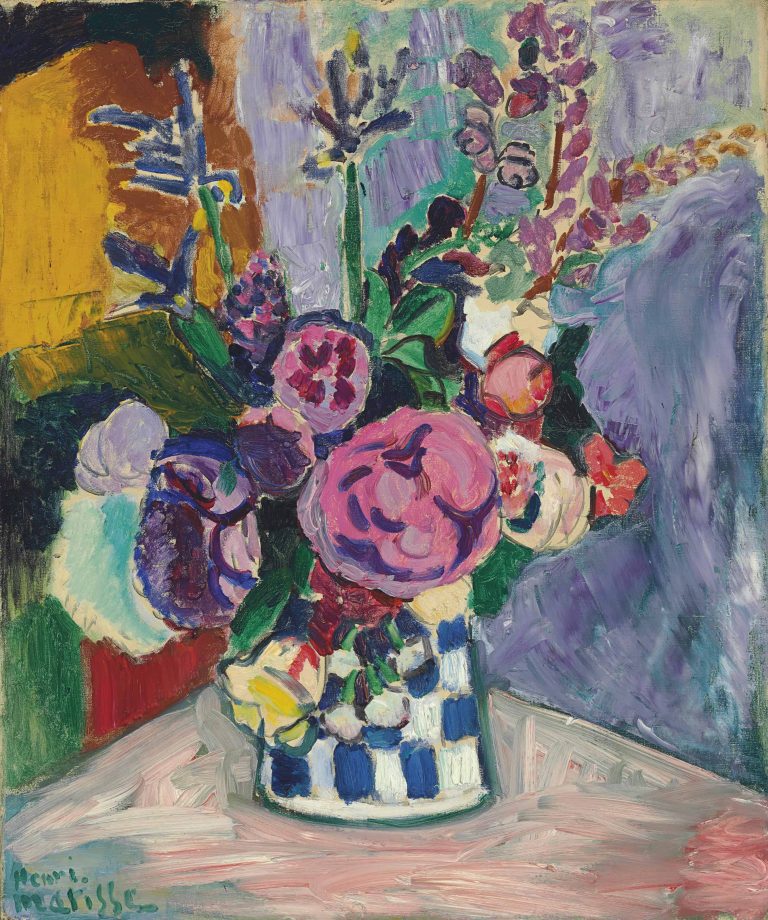
Henri Matisse,
Peonies,
1907
At the turn of the century, flowers became tools for both mystical dreaming and intricate ornamentation. Odilon Redon‘s pastel bouquets often appear to float in ethereal spaces, representing a bridge between the visible world and the subconscious.
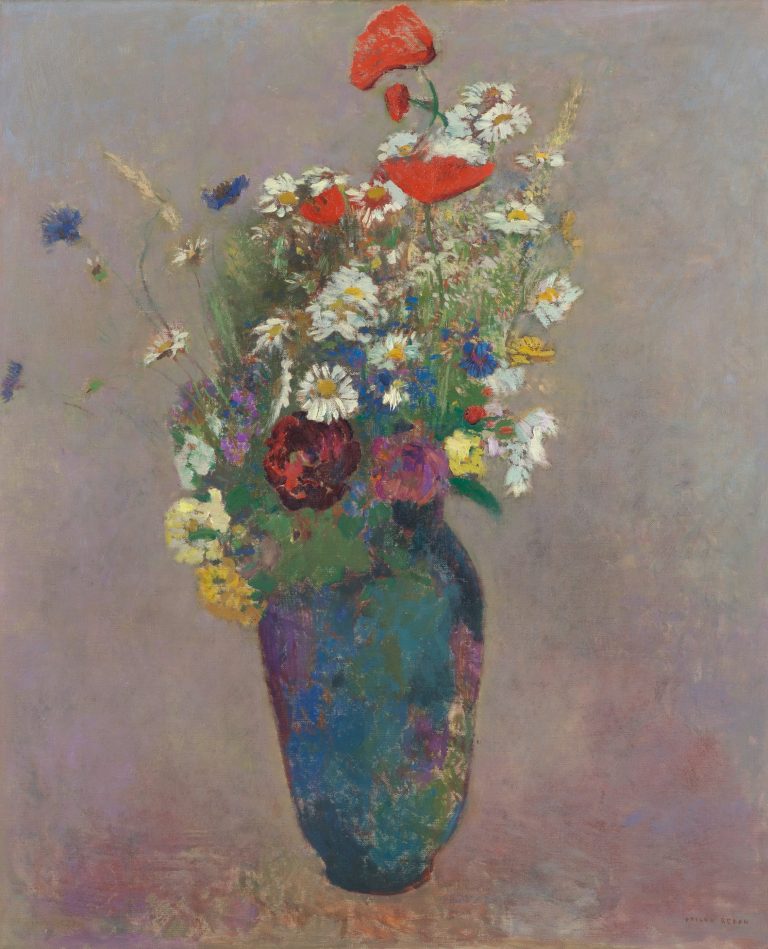
Odilon Redon,
Vase of Flowers,
1900
In contrast, Gustav Klimt used the floral motif to dissolve the boundaries between nature and decoration.
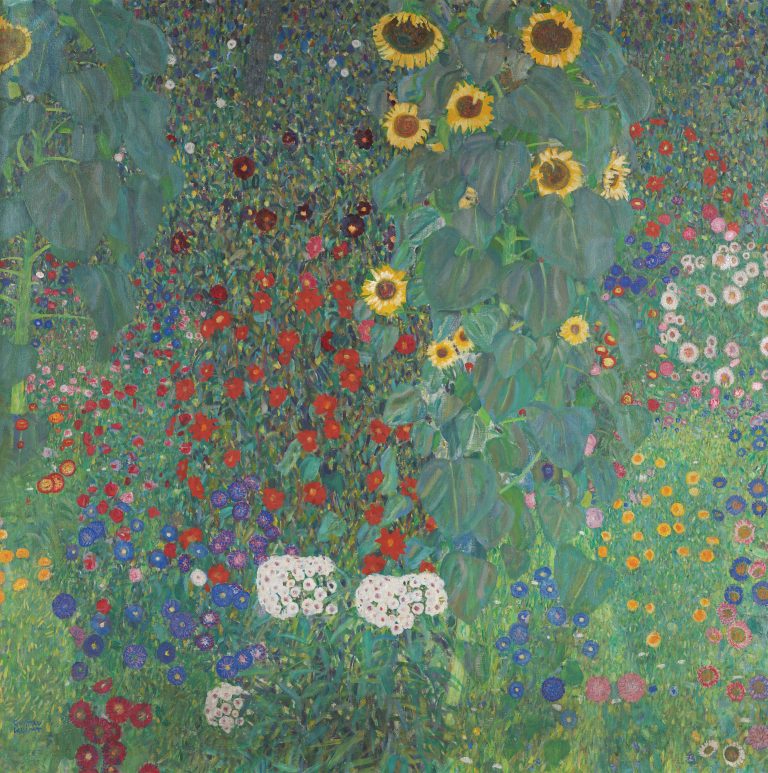
Gustav Klimt,
Farm Garden with Sunflowers,
1907
Emil Nolde transformed the floral motif into a visceral explosion of color and thick, gestural brushwork, capturing the raw, untamed energy of the natural world.
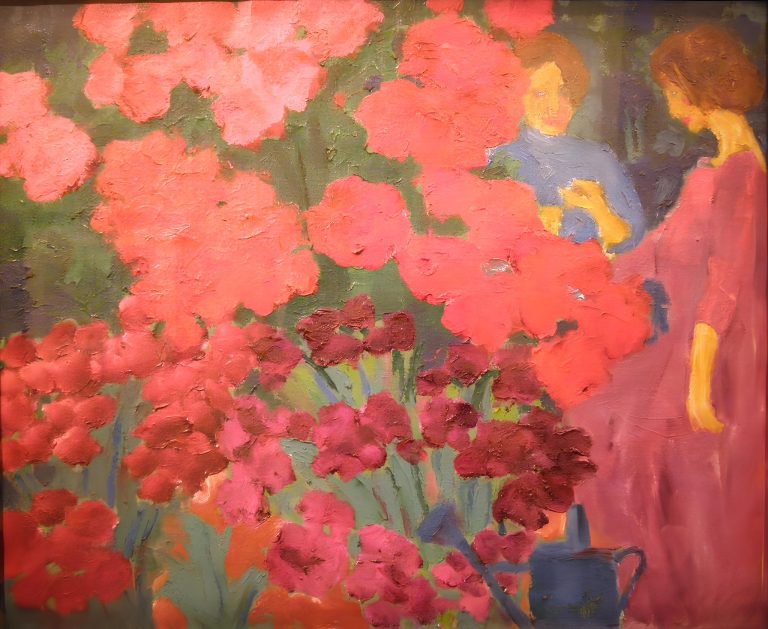
Emil Nolde,
Women in a Flower Garden,
1916
The Modern and Contemporary Bloom
As art entered the 20th and 21st centuries, flowers were magnified, simplified, and transformed into political statements.
- Magnification: Georgia O’Keeffe began enlarging flowers far beyond life-size in works like “Petunia No. 2” and “Black Iris III,” forcing the viewer to observe the minute details of the natural world.
- Pop Art: Andy Warhol’s “Flowers” series (1964) used mass-production techniques to transform a magazine photograph of hibiscus flowers into a repetitive, commercial icon.
- Sculptural Grandeur: Jeff Koons’ “Puppy” (1992) is a 40-foot-tall terrier covered in live flowering plants, while Yayoi Kusama’s “Flowers that Bloom at Midnight” uses polka-dotted blossoms to explore the whimsical and the magical.
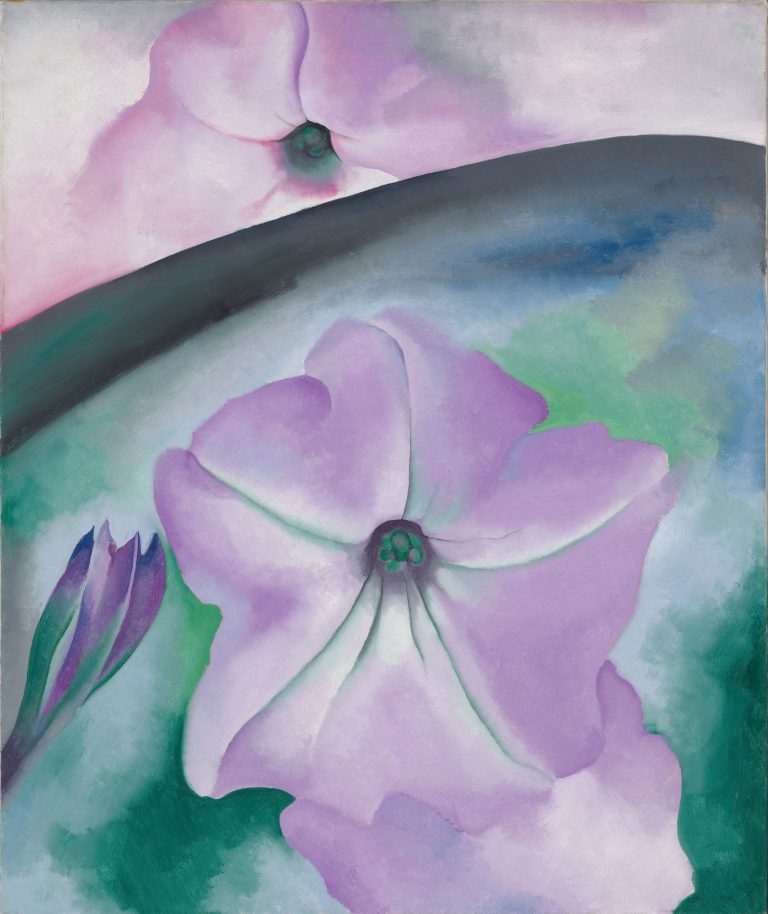
Georgia O’Keeffe,
Petunia No. 2,
1924
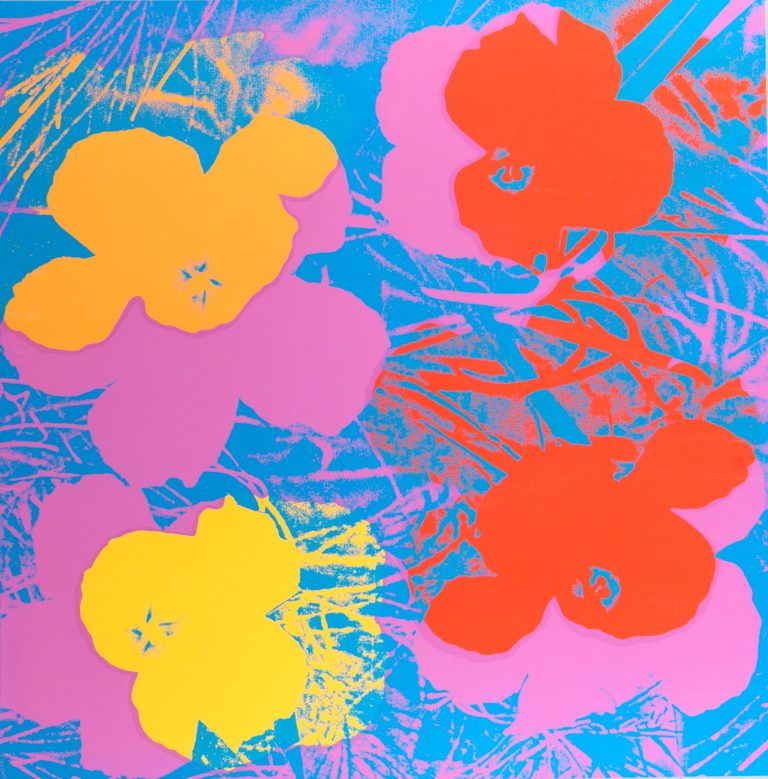
Andy Warhol,
Flowers,
1964
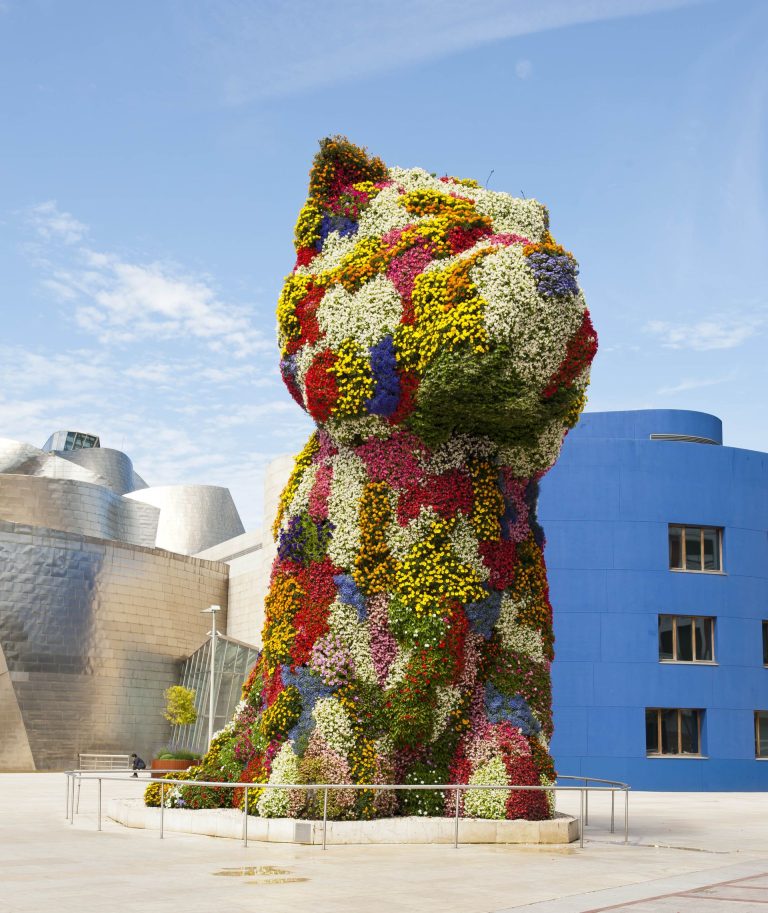
Jeff Koons,
Puppy,
1992
Flowers as Political Commentary
Contemporary artists have also used the fragility of flowers to address heavy themes. Anselm Kiefer’s “Let a Thousand Flowers Bloom” references Mao Zedong’s slogan to comment on the suppression of dissent. In the world of street art, Banksy’s “Love Is In The Air” replaces a weapon with a bouquet, turning an act of aggression into a symbol of peace.
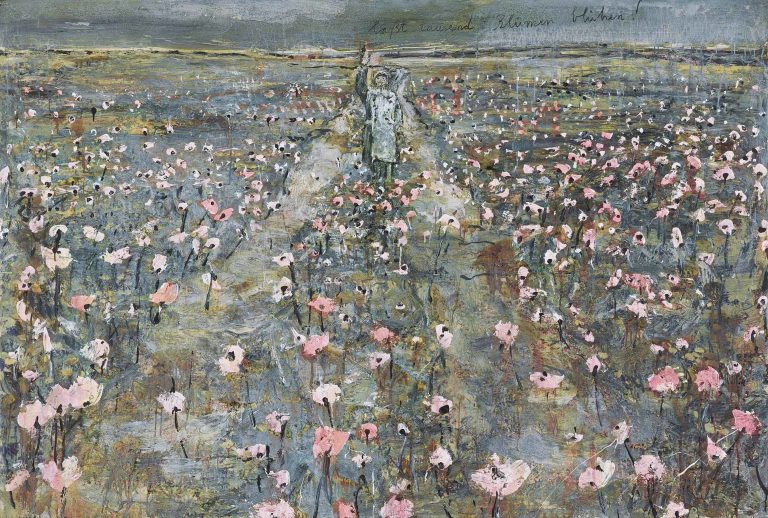
Anselm Kiefer,
Let a Thousand Flowers Bloom,
1999
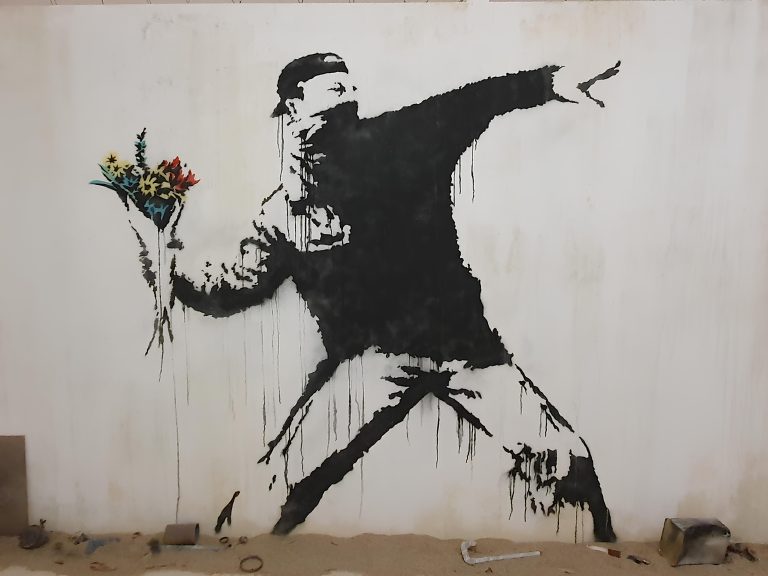
Banksy,
Love Is In The Air,
2003
Most recently, Marc Quinn’s 2024 exhibition “Light into Life” used 3D scanning and unconventional materials—including powdered animal blood—to create sculptures that question our relationship with nature and climate change.
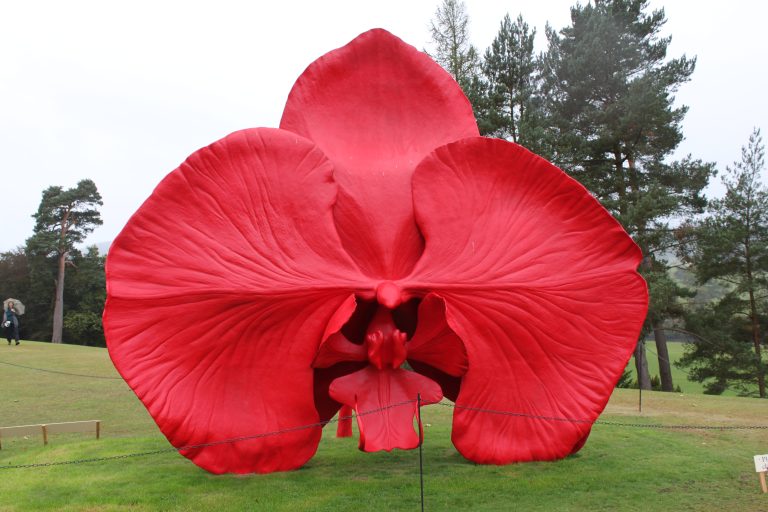
Marc Quinn,
Burning Desire,
2011
Conclusion: An Enduring Inspiration
Flowers have always held a central role throughout the history of art. Whether as religious symbols or emblems of power, they have also, of course, been depicted for their singular beauty, both in a naturalistic manner and as decorative motifs. In an era of rapid technological change and environmental fragility, how will the next generation of artists reinterpret the flower to reflect our changing relationship with nature?
Sources
Books
Lucia Impelluso, La Nature et ses symboles. Repères iconographiques, Hazan
Gérard-Julien Salvy (dir.), Le Petit Larousse des symboles
General Articles and Videos
New Scientist – Kew Gardens exhibition: Marc Quinn, Connaissance des Arts – Andy Warhol : Focus sur un chef-d’œuvre, DailyArt Magazine – Masterpiece Story: Red and White Cotton Roses by Li Di, Petal and Poem – 19 Art Masterpieces That Feature Flowers, Jacques Pépin Art – Flowers in Art History
Academic or Specialist Articles
Encyclopedia Britannica, Peinture Chan – Xieyi : Transcrire l’idée,
Collaborative Encyclopedias
Wikipedia, Wikimedia Commons, Wikiart, Artchive, ArtatBerlin, Singulart
Places and Artworks Related to the Topic
Nelson-Atkins Museum – White Lilacs in a Crystal Vase, Musée Cernuschi – Peintures chinoises fleurs et oiseaux, Eykyn Maclean, Gallerie degli Uffizi, Kew Gardens – Marc Quinn: Light into Life, Met Museum, Minneapolis Institute of Art (ARTSMIA), MoMA – Collection, Musée d’Orsay, Museo Nacional Thyssen-Bornemisza, Museo Reina Sofía, National Gallery of Victoria (NGV), O’Keeffe Museum, SFMOMA, British Council Visual Arts, Google Arts & Culture
Specific Works Mentioned
Diego Rivera – Flower Vendor / Vendedora de Flores, Gustav Klimt – The Sunflowers, Marc Quinn – Garden, Mary Cassatt – Lilacs in a Window, Alexej Jawlensky – Blumenstilleben, P.J. Redouté – Les Roses, Sotheby’s – 19th Century European Paintings, Henri Matisse – The Art Story, AbeBooks – Flower Vendor (Rivera)