


From ancient cave paintings to contemporary digital art, trees have remained a powerful symbol in artistic expression. They represent life, growth, wisdom, and the passage of time. Artists across cultures and centuries have used trees to convey spiritual, philosophical, and even political messages. In this article, we explore how trees have been depicted in different artistic periods and what they reveal about humanity’s relationship with nature.
👉 Watch the complete video on YouTube.
Trees in Ancient and Medieval Art
The earliest known artistic representations of trees date back to antiquity. In ancient civilizations such as Egypt and Mesopotamia, trees held religious significance.
This funerary fresco from the tomb of Nebamon, housed in the British Museum, depicts one of the earliest enclosed gardens with a central pool and trees symbolizing abundance, designed not for aesthetics but to preserve the essential elements of the deceased’s life.
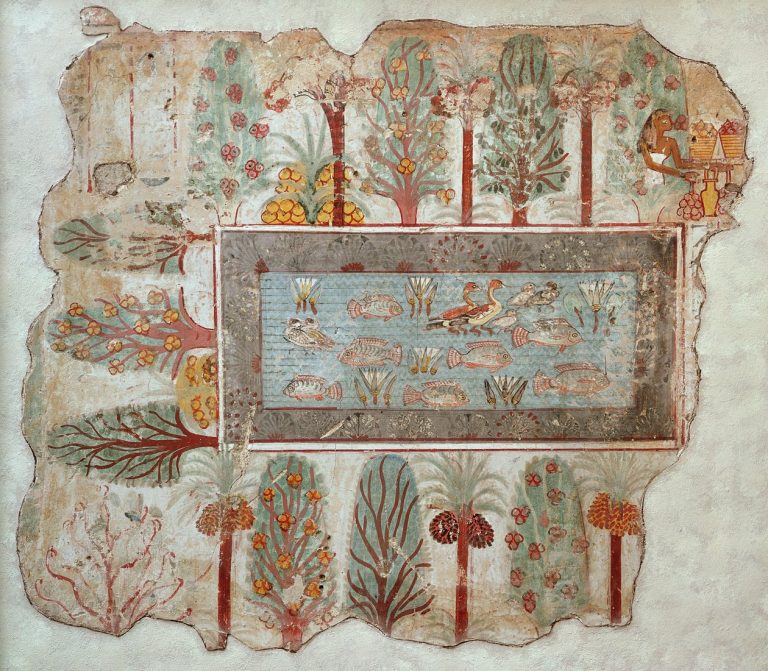
Garden of a private estate with an ornamental pool,
part of the wall painting from the Tomb of Nebamun,
régisseur de l’épouse de Thoutmôsis IV.,
Thebes, Egypt, c.1350 BCE
In medieval art, trees took on a more structured, symbolic role, often appearing in religious manuscripts and frescoes. The biblical Tree of Knowledge and the Tree of Life were common motifs, illustrating themes of temptation, salvation, and divine wisdom. The medieval period also saw the rise of stylized trees in illuminated manuscripts, where they were used to frame and decorate religious texts.
In the 15th century, trees were often portrayed as delicate, symmetrical, and idealized, typically positioned in the background, as seen in Fra Angelico’s The Flight into Egypt (c. 1450).
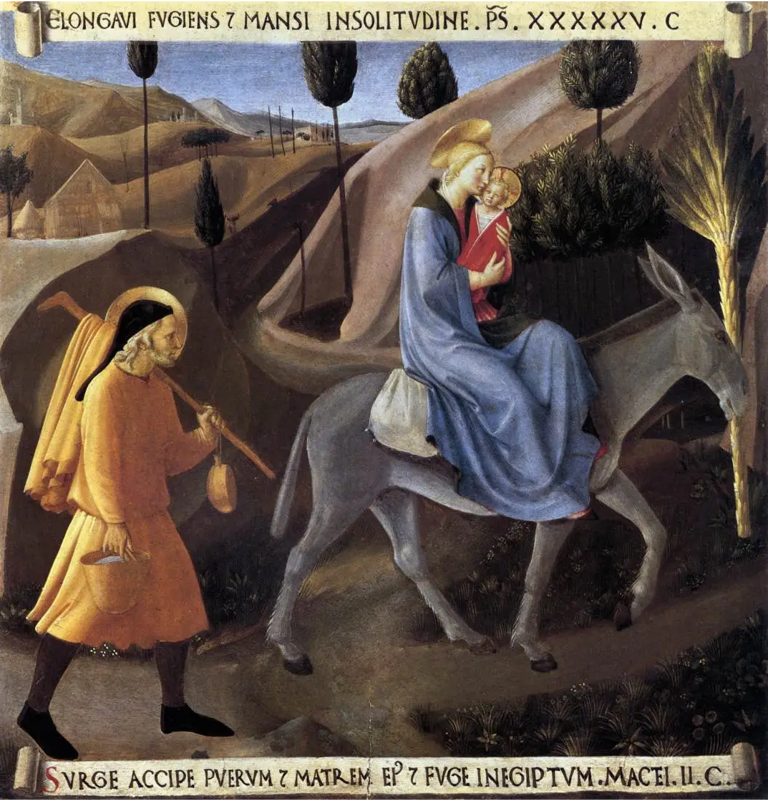
Fra Angelico, Flight into Egypt, 1451 – 1452
The Renaissance: Nature and Realism
The Renaissance brought a renewed interest in nature and realism. Artists like Leonardo da Vinci and Albrecht Dürer studied trees meticulously, capturing their intricate branches and leaves with scientific precision. Trees in Renaissance paintings often had a dual purpose: they provided depth and perspective while also symbolizing themes of renewal and knowledge.
In Giovanni Bellini’s painting The Assassination of Saint Peter Martyr, the scene is set within a grove of evergreen oaks.
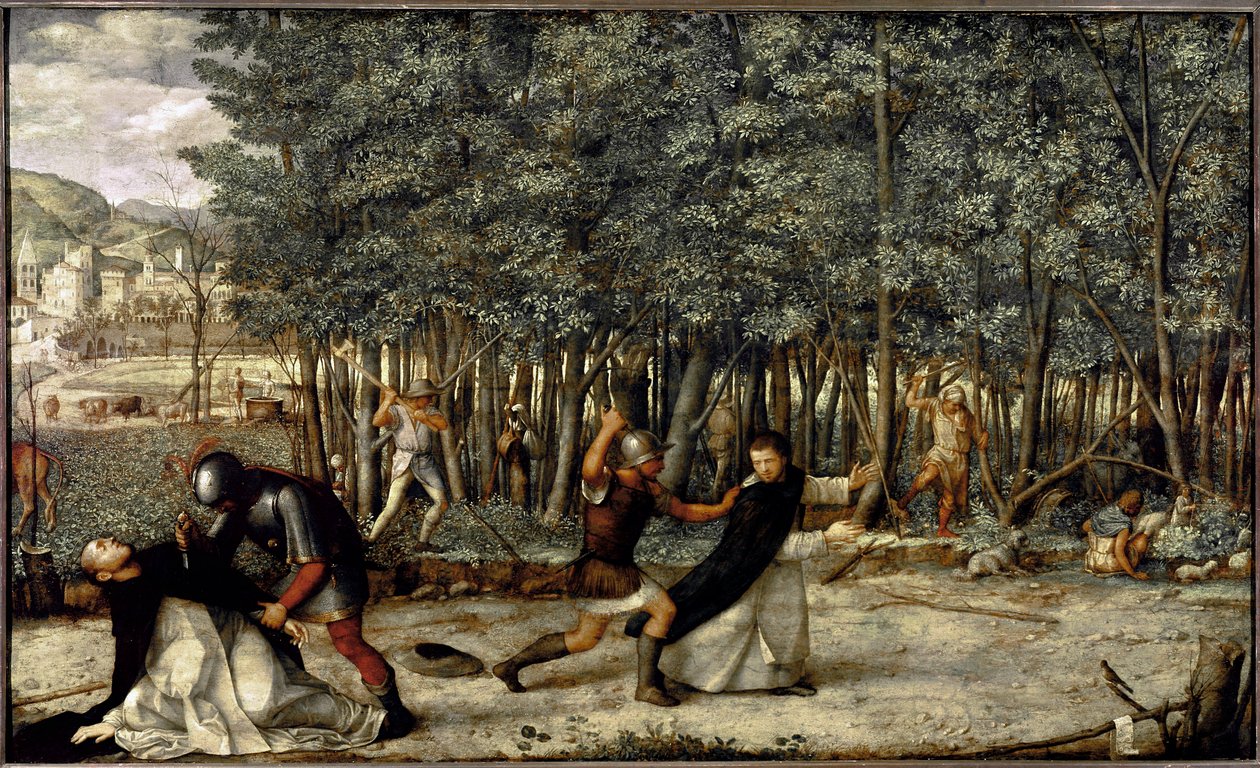
Giovanni Bellini, The Assassination of Saint Peter Martyr, c.1507
The painting Adam and Eve by Lucas Cranach the Elder, an iconic work of its time, places the Tree of Knowledge at the center of the scene. It stands out for its delicate depiction of nature and human figures.
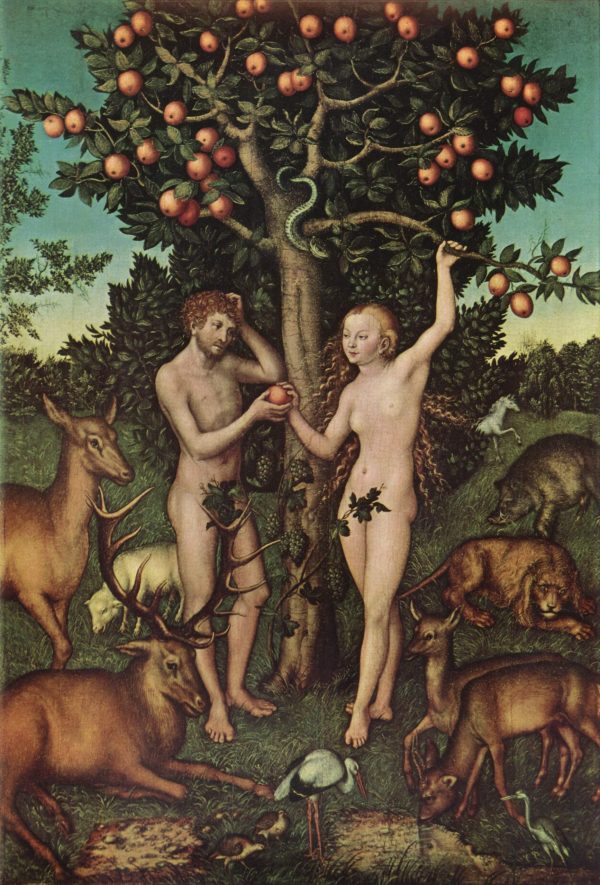
Lucas Cranach the Elder, Adam and Eve, 1526
The Renaissance marked a shift where trees were not just decorative elements but integral to storytelling and composition.
The 17th Century: The Rise of Landscape Painting
The 17th century saw the rise of landscape painting, particularly in Italy, where artists like Claude Lorrain idealized the Mediterranean landscape with trees such as umbrella pines and oaks, influencing European park designs. In his Pastoral Landscape, Lorrain’s towering trees symbolize harmony between humanity and nature.
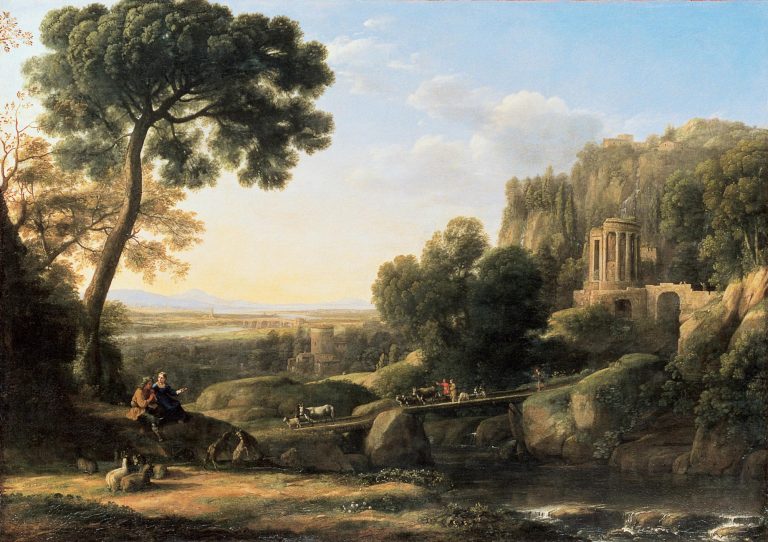
Claude Gellée (Le Lorrain), Pastoral Landscape, 1644
Meanwhile, in the Dutch Republic, painters like Roelandt Savery focused on realistic depictions of trees, such as stumps and fallen branches. Jacob van Ruisdael, known for his realistic landscapes, portrayed trees like the imposing oak in The Great Oak, where nature becomes a central and commanding element in the composition.
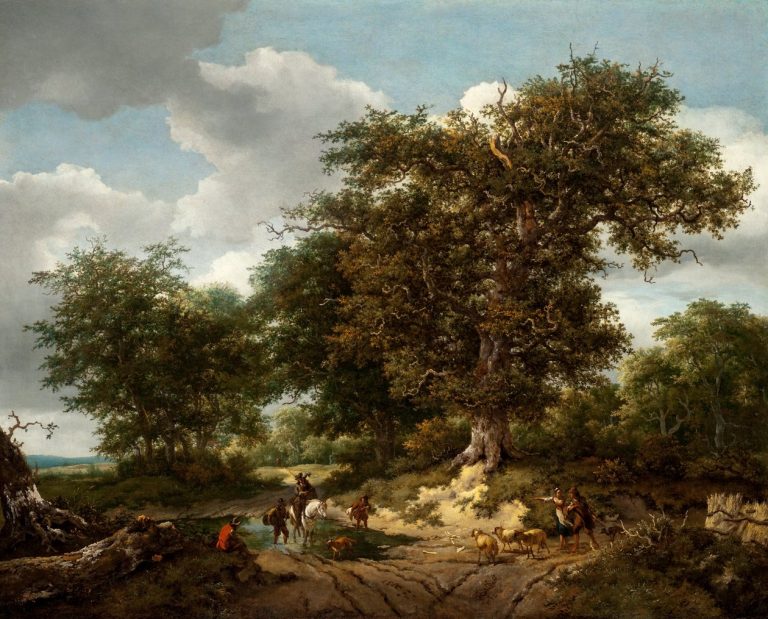
Jacob van Ruisdael, The Great Oak, 1652
Rococo and Neoclassical Romance
A few decades later, Fragonard’s The Swing immerses us in a verdant park where a young woman joyfully swings, tossing her shoe toward her lover, the Baron, who collapses among the flowers. The unsuspecting husband pushes the swing, unaware of the affair. The lush vegetation and light play enhance the intimate, libertine atmosphere, reflecting the frivolity and desire of the Rococo style.
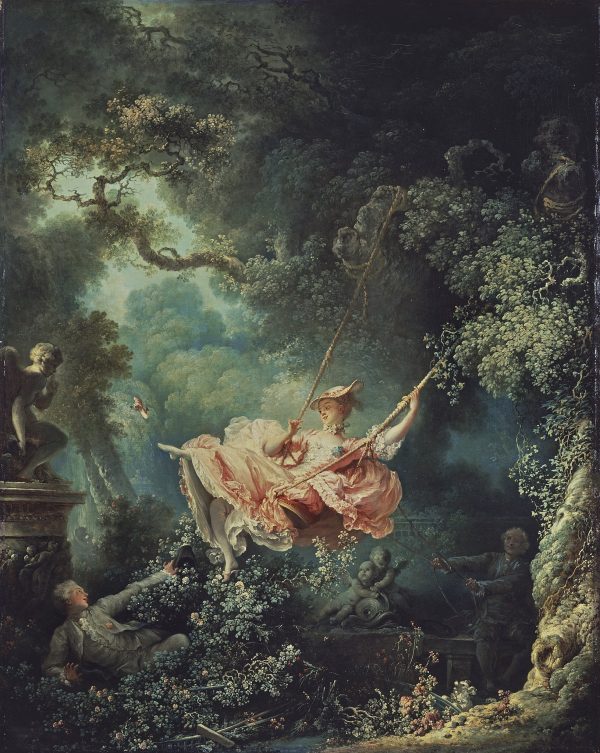
Jean-Honoré Fragonard, The Swing, c. 1730–1735
Hubert Robert’s The Bathers’ Pool depicts a ruined temple with statues and contemporary bathers, blending the ancient with the present. Commissioned for the Château de Bagatelle’s bathroom, it shows Robert’s fascination with Italian landscapes and aquatic scenes.
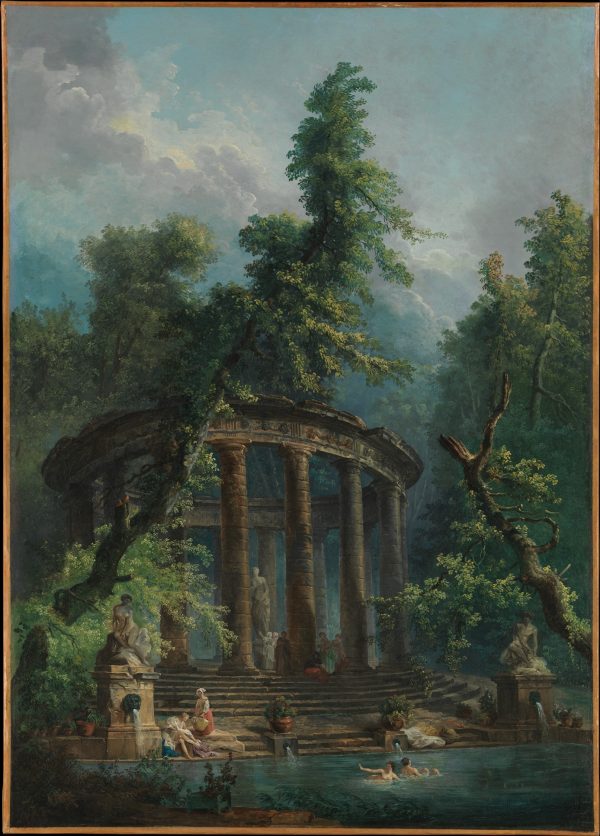
Hubert Robert, The Bathing Pool, c. 1780
The Tree as a Central Motif in Romantic Art
In 1816, the Grand Prix de Rome for landscape painting was created, with the tree becoming a central motif, leading to the “tree competition” in 1817. From 1830 to 1860, the tree became a key element in many artists’ works.
John Constable’s The White Horse, the first of his famous “six-footers,” depicts scenes along the River Stour, highlighting his strong connection to the English countryside and his passion for rural landscapes.
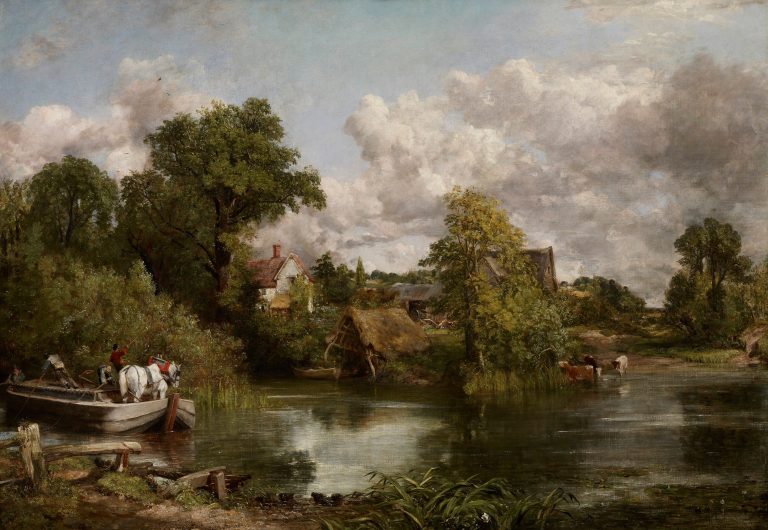
John Constable, The White Horse, 1819
On the other hand, Gustave Courbet’s Le Chêne de Flagey portrays an imposing oak, symbolizing the raw power of nature through realism.
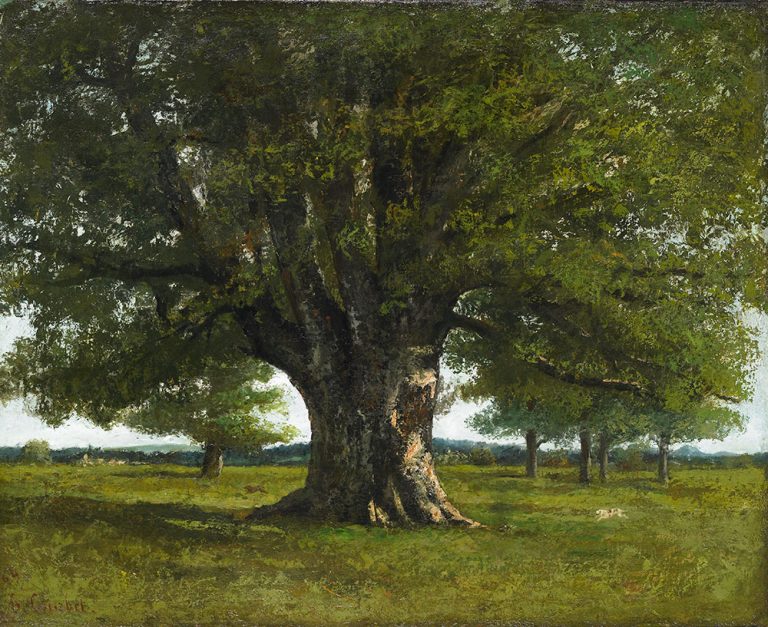
Gustave Courbet, The Oak of Flagey, 1864
The Impressionism and Its Legacy
In the 1860s, a new generation of artists, including Degas, Monet, Renoir, and Cézanne, broke away from academic traditions. Monet, in his early work Le Chêne Bodmer, used composition and color to highlight the majestic oak. By 1870, in Corner of the Garden at Montgeron, Monet fully embraced Impressionism, focusing on light and color rather than realistic detail.
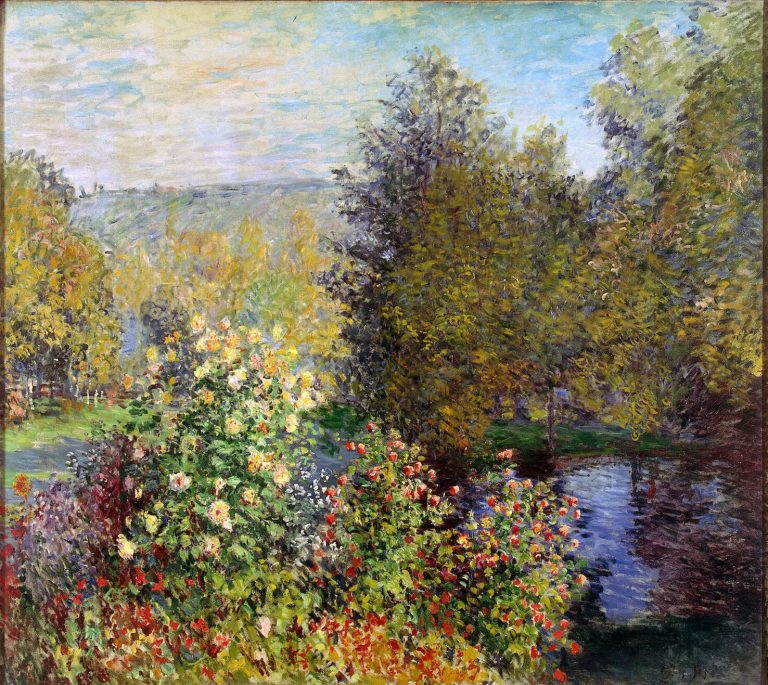
Claude Monet, Corner of the Garden at Montgeron, 1876
In the United States, the Hudson River School emerged, celebrating the grandeur of nature. Artists like Albert Bierstadt and John Frederick Kensett embraced luminism, a branch of the Hudson River School, focusing on light and subtle details rather than grandiose representations.
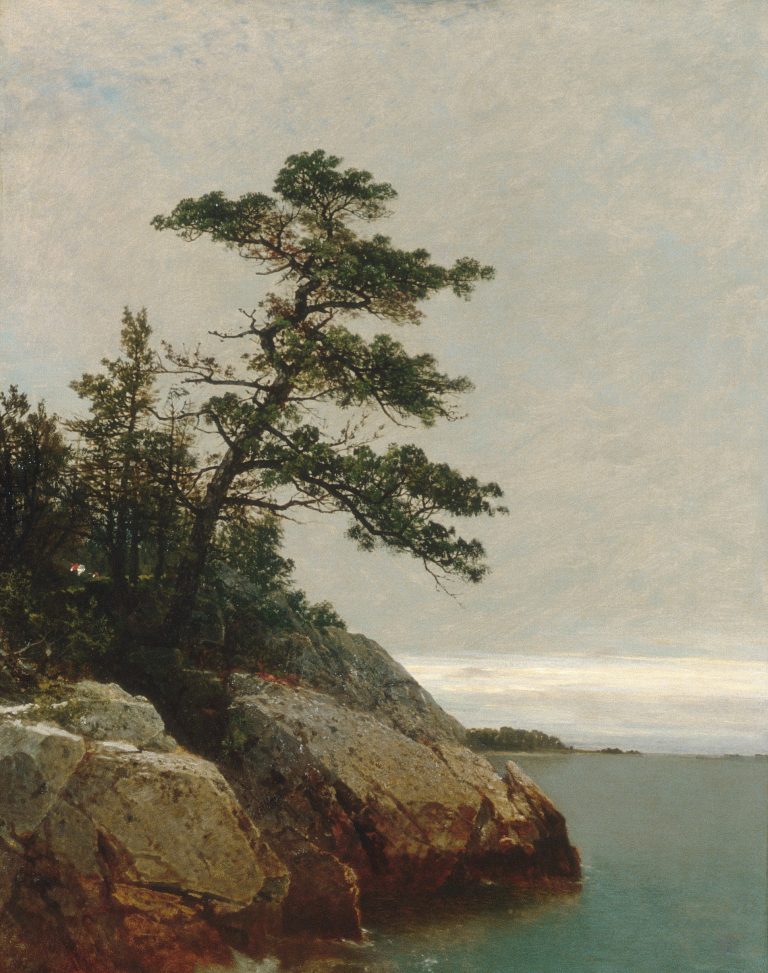
John Frederick Kensett, The Old Pine, Darien, Connecticut, 1872
In France, at the end of the 19th century, artists like Paul Gauguin and Vincent van Gogh moved away from naturalism. Gauguin’s Blue Trees used bold, non-naturalistic colors to convey emotion, while Van Gogh, during his stay at Saint-Paul-de-Mausole, created works like Olive Trees with the Yellow Sky to express the intensity of nature. Paul Cézanne, in Large Pine and Red Earth, used earthy tones and geometric forms to express the essence of the Provençal landscape, foreshadowing Cubism.
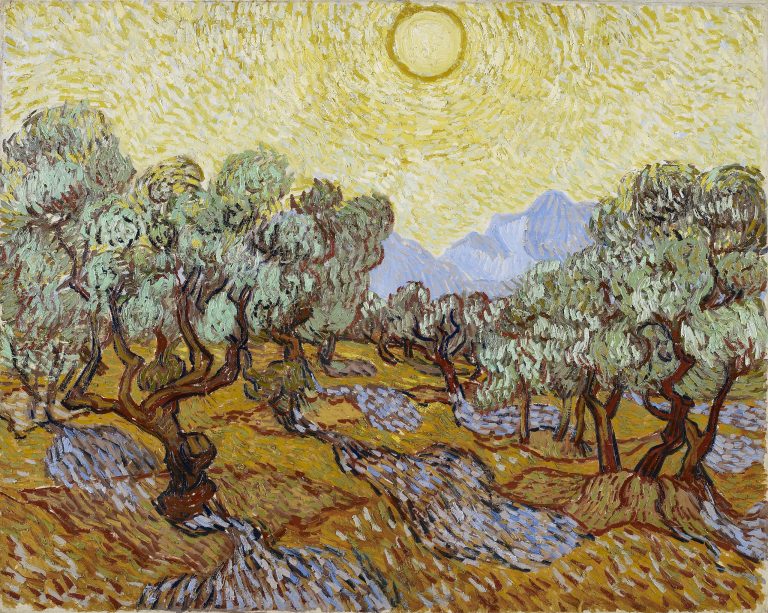
Vincent van Gogh, Olive Trees with the Yellow Sky, 1889
In the 19th century, Japonism emerged in Europe following Japan’s opening to the world in 1853, allowing Westerners to discover Japanese art, particularly ukiyo-e prints, which depicted fleeting moments and ephemeral pleasures. The works of French painter and lithographer Henri Rivière, known for his landscapes and prints, clearly reflect the influence of Japan, especially through his stylized vegetation and the use of forms and colors inspired by Japanese prints.
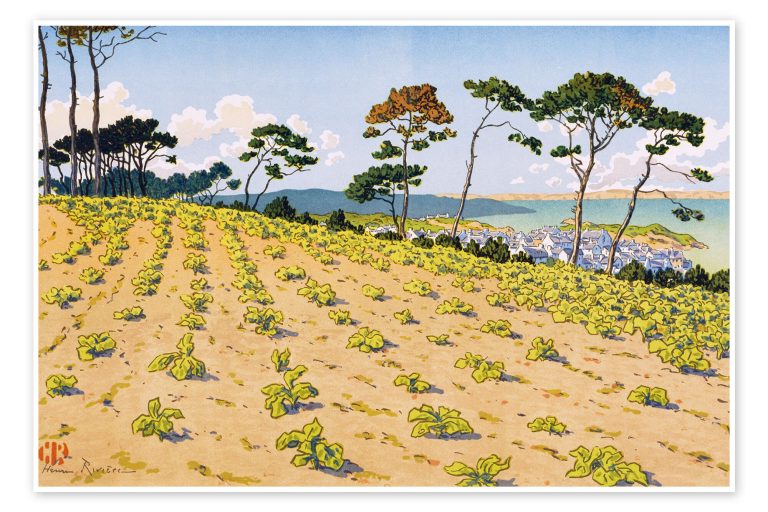
Henri Rivière, The Bay of Douarnenez, 1892
Starting in 1888, the Nabis movement, led by Paul Sérusier, developed an aesthetic characterized by simplified shapes, flat planes of color, bold outlines, and a touch of symbolism and spirituality. Maurice Denis’s Green Trees presents nature through a symbolic perspective, emphasizing shapes and colors to evoke a poetic, dreamlike atmosphere. In The Clearing (Edge of the Wood), Paul Ranson captures a landscape with a more intimate approach, blending light and shadow to create a serene yet mysterious mood. The use of light separates the planes, with the foreground in shadow and the background illuminated.
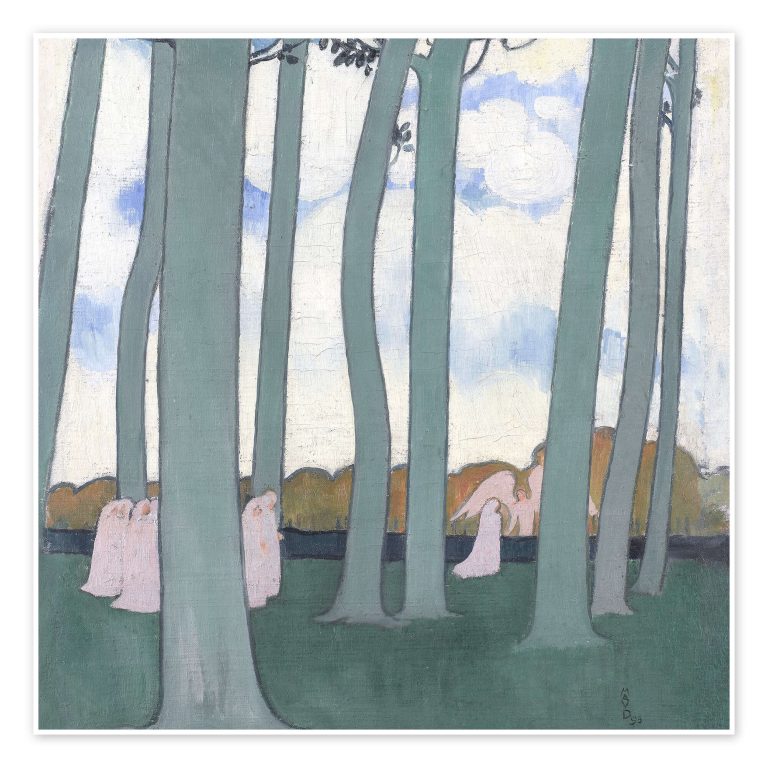
Maurice Denis, Green Trees, 1893
In The Snake Charmer, the lush vegetation and tropical trees evoke a jungle atmosphere, depicted in a naïve style with vibrant colors.
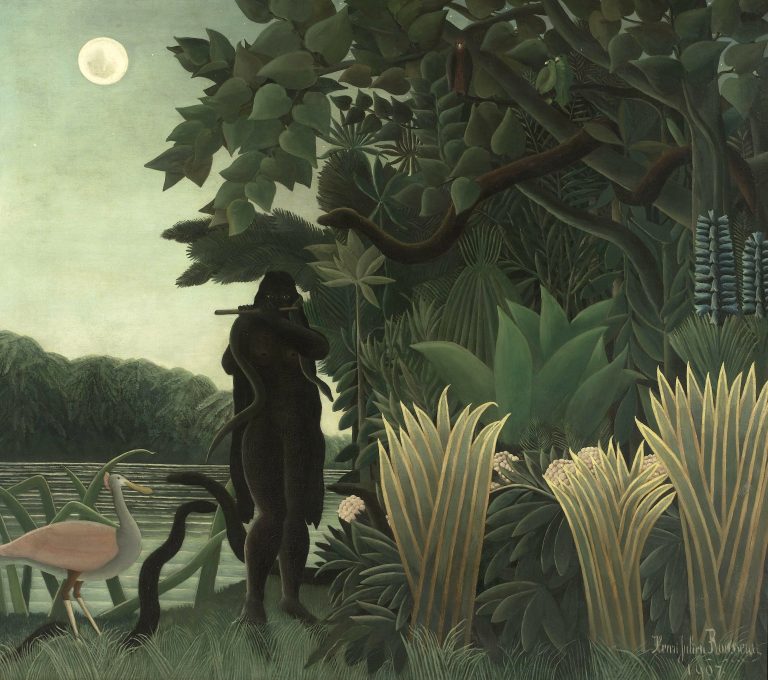
Henri Rousseau, The Snake Charmer, 1907
In 1909, Paul Signac presented The Pine Tree at Saint Tropez, a vibrant example of the pointillist movement, capturing natural light and color through small, juxtaposed strokes of paint.
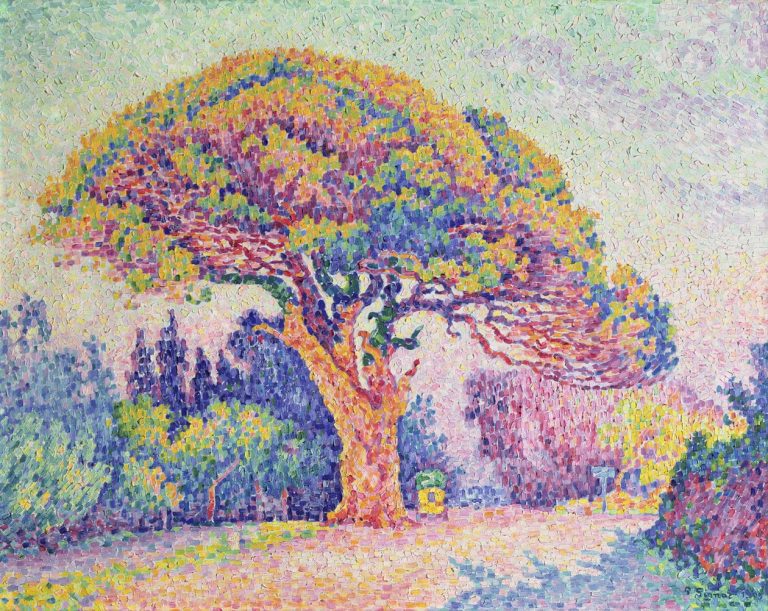
Paul Signac, The Pine Tree at Saint Tropez, 1909
A shift towards abstraction
At the turn of the century, the landscape and tree genres are becoming less prominent. Artists began to retreat from plein air painting and work in studios. While figurative themes still prevailed, the first signs of geometric forms emerged, and trees were often stylized.
Klimt’s The Tree of Life (1905-1909) from his Golden Period combines symbolism and decorative motifs to represent life, growth, and spiritual connection.
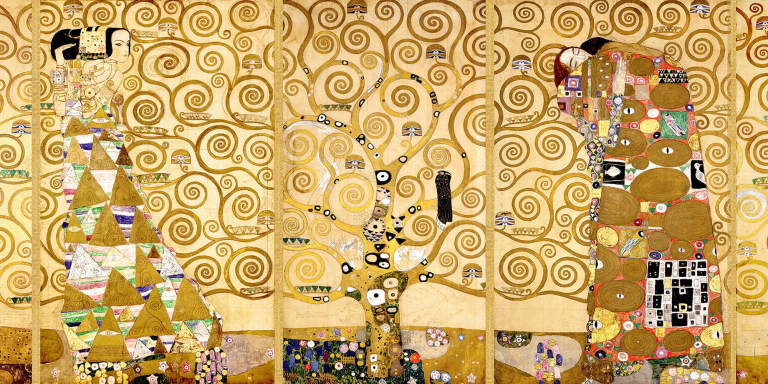
Gustav Klimt, The Tree of Life, 1909
Picasso’s Landscape with a Tree (1907) marks his early Cubist experimentation, presenting a fragmented tree in geometric facets.
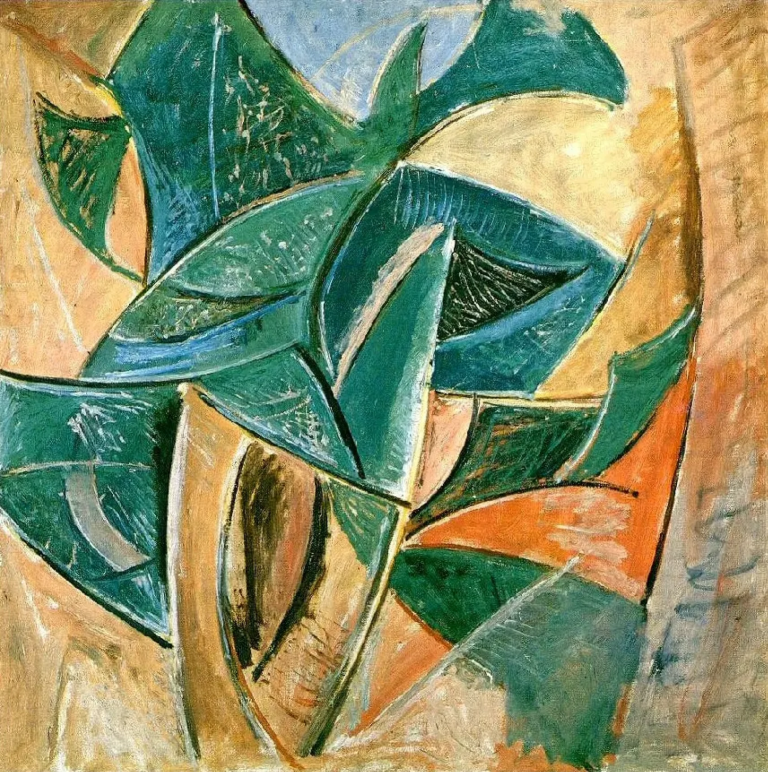
Pablo Picasso, Landscape with a Tree (Tree Summer), 1907
Mondrian’s The Red Tree (1908) takes a minimalist, geometric approach, transforming the tree into an almost abstract form with dynamic energy.
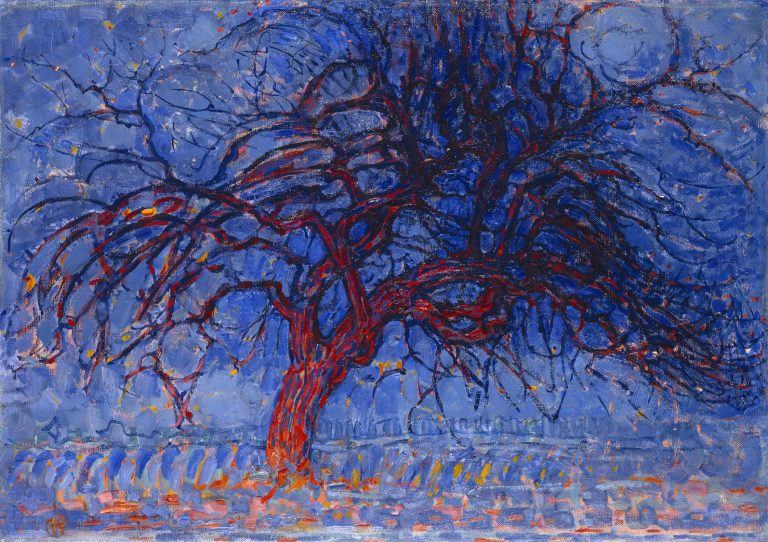
Piet Mondrian, The Red Tree, 1908–1910
In 1911, Edvard Munch painted The Yellow Log, depicting a fallen tree trunk—a theme he would revisit in The Lumberjack the following year. The fallen trunk is rendered expressively, with exaggerated perspective adding depth, while vivid colors, particularly yellow, emphasize the symbolic nature of the subject.
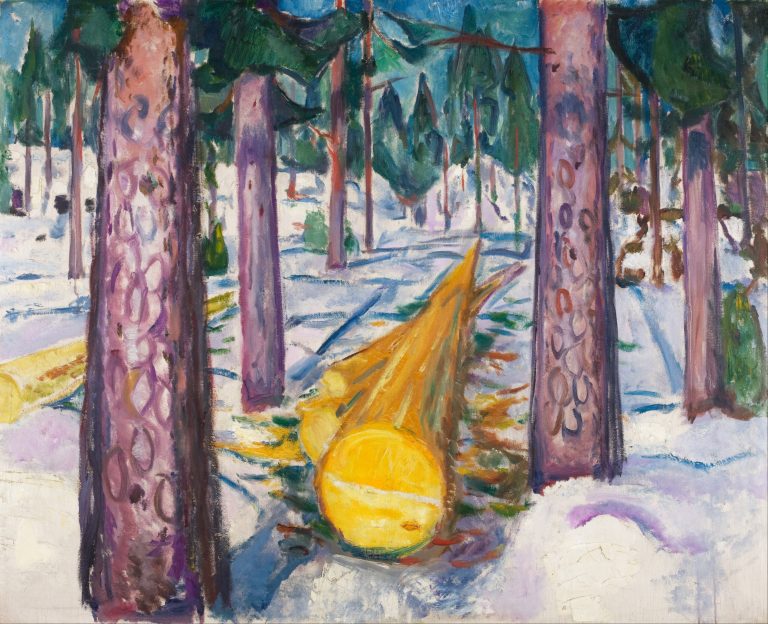
Edvard Munch, The Yellow Log, 1912
The Surrealist approach
Max Ernst’s The Forest is a surrealist piece that explores dreamlike landscapes, using his unique scratching technique to reveal abstract forms, with forests symbolizing the unconscious and the hidden mysteries of the human mind.
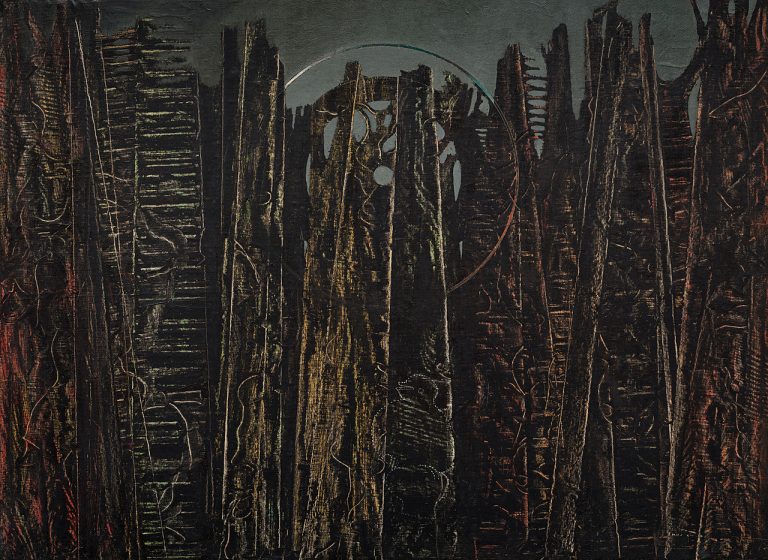
Max Ernst, The Forest, 1927
The “Tree of Scholars,” a symbol of wisdom in Asian cultures, is echoed in Simon Hantaï’s vibrant work (1950-1951), where he blends tradition and contemporary art. Influenced by Ernst, Hantaï used unconventional tools like razors and knives to create textured layers, incorporating natural elements.
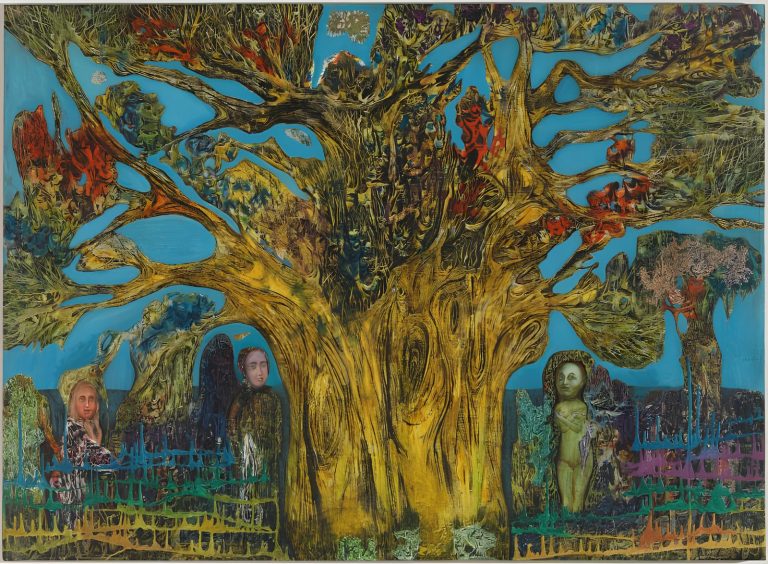
Simon Hantaï, The Scholars’ Tree, 1950–1951
Frida Kahlo’s El Congreso de los Pueblos por la Paz, one of her final works, features a tree holding a dove, symbolizing Mexico’s cultural roots and hope for peace. The painting also honors Afro-Mexican heritage and Kahlo’s commitment to an inclusive, politically engaged Mexican identity.
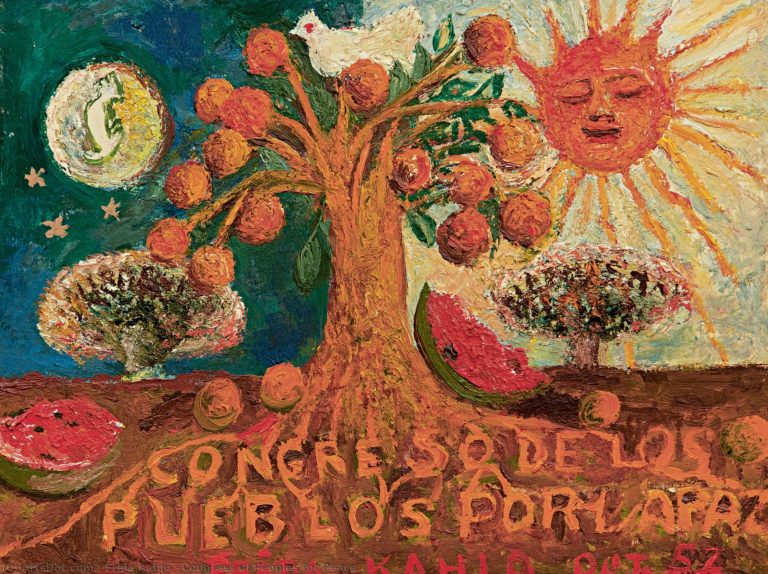
Frida Kahlo, El Congreso de los Pueblos por la Paz, 1952
Contemporary Perspectives on Trees
Contemporary artists like Keith Haring and David Hockney offer vibrant and bold interpretations of trees through their use of color.
Keith Haring’s Tree of Monkeys combines graffiti and pop art, with small creatures symbolizing humanity in a joyful, interconnected community. His bold, thick black outlines and vibrant colors convey an optimistic view of life and collaboration.
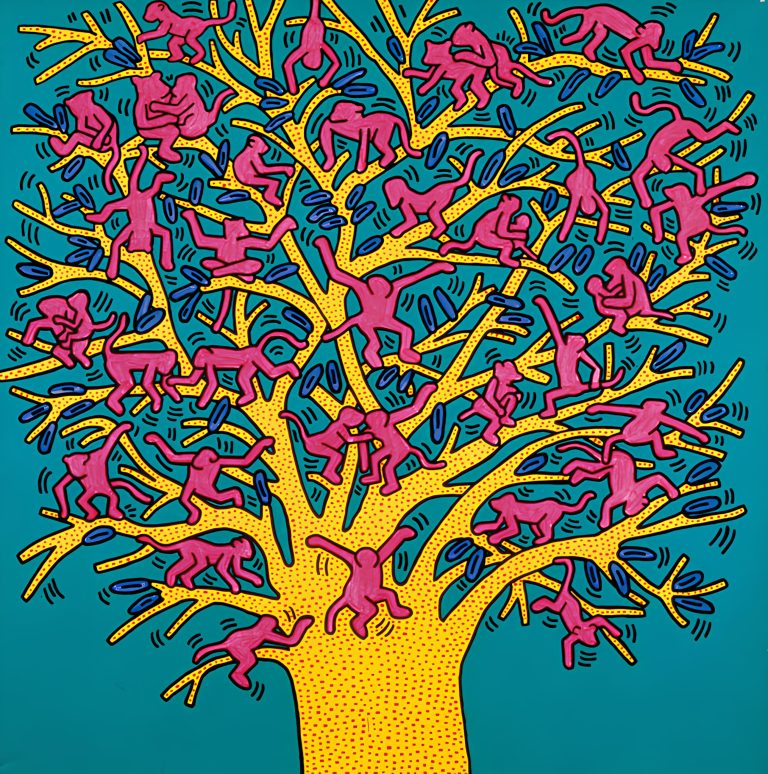
Keith Haring, Tree of Monkeys, 1984
David Hockney’s The Arrival of Spring in Woldgate is a giant, colorful depiction of nature, capturing the vibrancy and vitality of the season.
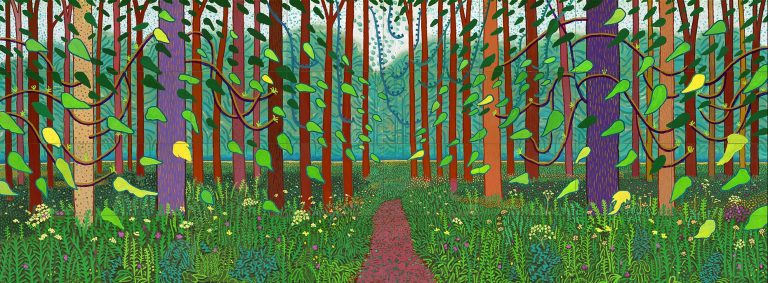
David Hockney, Arrival of Spring, 2011
Others have taken a more conceptual approach, sometimes through innovative sculptural approaches. Alexander Calder’s kinetic sculptures transform nature into abstract, moving forms, Christo and Jeanne-Claude’s Two Wrapped Trees reimagines eucalyptus trees in Australia by wrapping them in fabric and Greek artist Pavlos’s Tree uses everyday materials like paper and plexiglass to create an intricate sculpture that stands 310 cm tall.
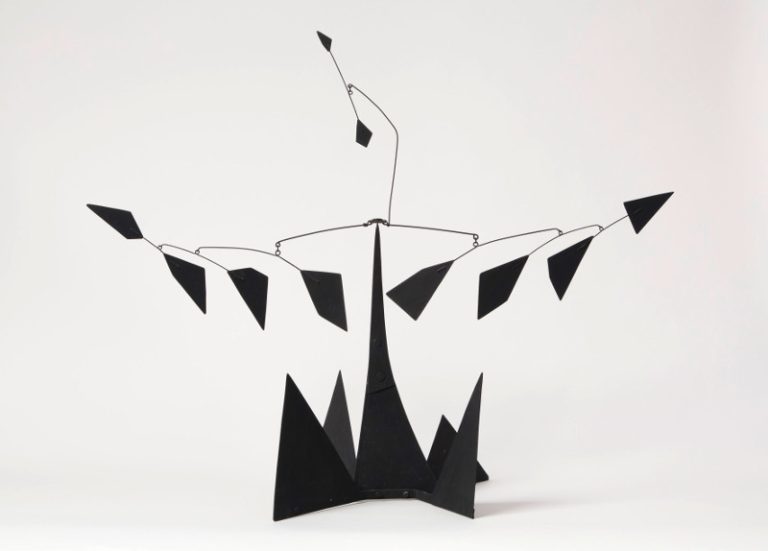
Alexander Calder, Tree, 1960
Contemporary artists also use trees to address environmental concerns, deforestation, and the impact of industrialization. Ai Weiwei’s Iron Tree, made of metal, questions the relationship between nature and human intervention. Maya Lin’s Ghost Forest and Ghost Forest Baseline installations aim to raise awareness about biodiversity loss and the impact of climate change on forests.
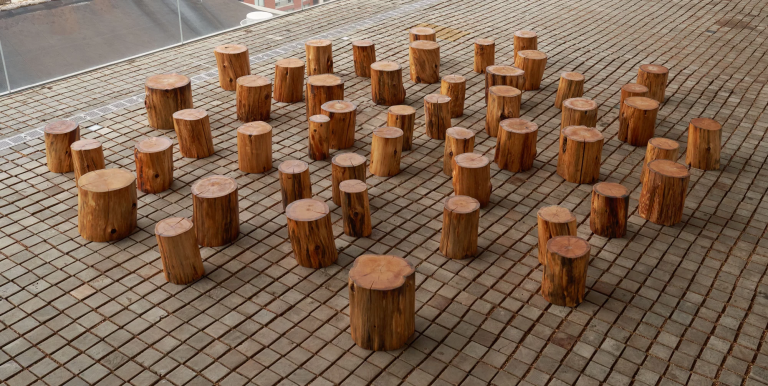
Maya Lin, Ghost Forest Baseline, 2021
Similarly, artists working in land art, like Andy Goldsworthy, use real trees and natural materials, like the sycamore tree’s leaves in a gradient of colors, to create ephemeral works that highlight the beauty and fragility of the natural world.
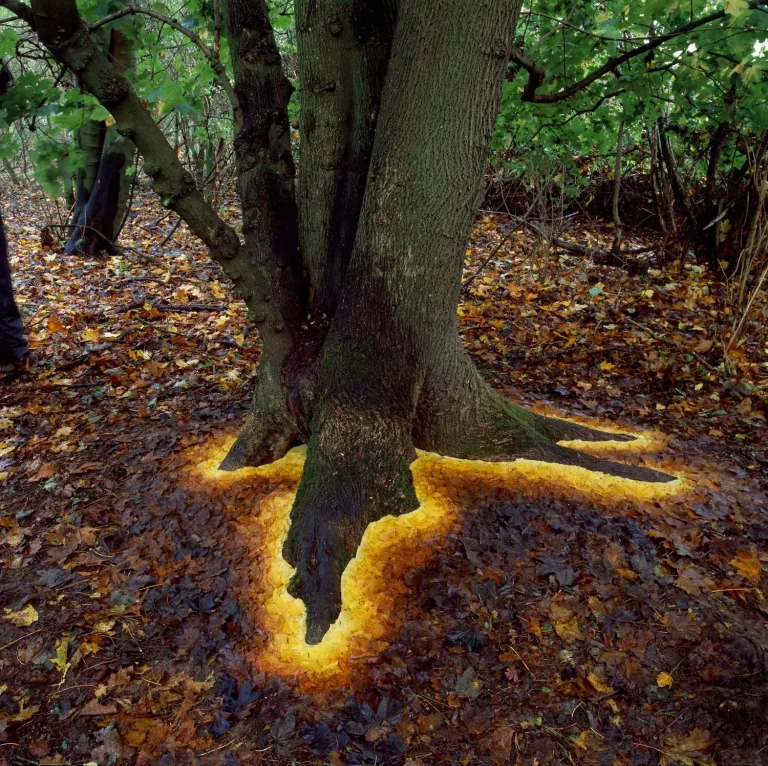
Andy Goldworthy, Sycamore leaves edging the roots of a sycamore tree, 2013
in the end...
Throughout history, trees have been more than just elements of the landscape in art. They have been vessels of meaning, carrying cultural, religious, and emotional significance across time. Whether depicted as symbols of knowledge, expressions of artistic style, or statements on the environment, trees remain a profound and enduring subject in visual art. As our relationship with nature continues to evolve, so too does the way artists interpret and represent trees in their work.
So… which tree scene struck you the most? Let me know in the comments — and check out the full video on YouTube for more beautiful tree paintings.


I’m an art teacher and I’m doing a unit on trees this will be a great resource!!
Great, I’m glad this article is helpful to you! I also have a YouTube channel ArtoriaTV where I cover different topics. There’s more content on the channel for now since I’m a bit behind on blog articles due to lack of time. Feel free to check it out with your students if you’d like. Looking forward to hearing from you. 🙂